How to Choose the Right Electrostatic Precipitator
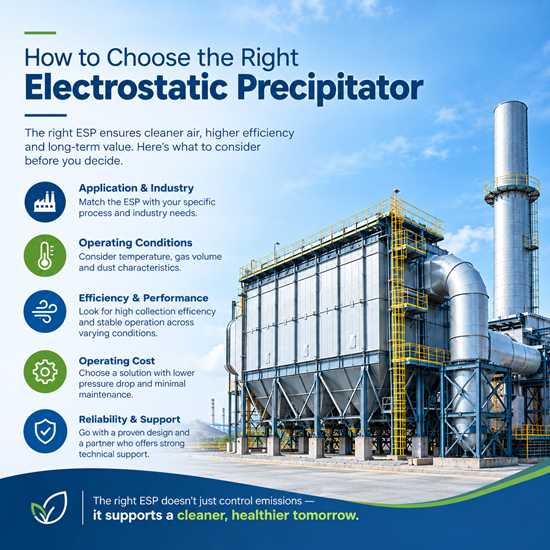
An Electrostatic Precipitator (ESP) is one of the most efficient technologies available for removing fine particulate from large-volume industrial exhaust gas streams. But "buy an ESP" isn't a single decision — it's a series of engineering choices, and getting any one of them wrong can mean a system that's compliant on paper but underperforms in daily operation. This guide walks through exactly what to evaluate, in order, before you choose one.
How an Electrostatic Precipitator Works
An ESP removes particulate through electrostatic attraction: exhaust gas passes through a chamber where discharge electrodes generate a corona — a region of ionized gas — that imparts an electrical charge onto particulate suspended in the gas stream. The charged particles then migrate toward grounded, oppositely charged collection plates, where they accumulate before being periodically removed.
The diagram below shows this process end to end, from gas inlet through to stack discharge:

Gas inlet and distribution ensures gas flow is spread evenly across the field zone — uneven distribution reduces effective treatment time for part of the gas stream. The charging zone is where discharge electrodes impart charge to particulate. The collection zone is where charged particles migrate to grounded plates under the electric field. The rapping system periodically dislodges the accumulated dust cake from the plates into a hopper below, from where it's removed for disposal or reuse. Clean gas continues to the ID fan, which provides the airflow to draw gas through the entire system, and finally to stack discharge.
Step 1: Define Your Actual Process Parameters
Before evaluating any ESP specification, you need real data from your process — not estimates:
- Gas volume (Nm³/hr or ACFM) at actual operating conditions
- Gas temperature at the ESP inlet
- Particle size distribution of the dust in your exhaust stream
- Dust resistivity — this single factor affects ESP performance more than almost any other variable
- Gas moisture content and corrosiveness
- Required outlet emission limit (mg/Nm³) that the system must consistently achieve
Any ESP quoted without this data is a generic estimate, not an engineered solution — and it's the single biggest reason plants end up with a technically "installed" ESP that still can't hold compliance in practice.
Step 2: Understand Why Dust Resistivity Is the Deciding Factor
Dust resistivity — how easily electrical charge moves through the collected dust layer — governs how well an ESP actually performs, independent of plate size or gas volume:
- Low resistivity dust loses its charge too quickly at the collection plate, allowing particles to re-entrain into the gas stream before they can be captured effectively.
- High resistivity dust causes a phenomenon called back corona — the dust layer itself begins to break down electrically, releasing ions that counteract the intended charging process and sharply reduce collection efficiency.
- Moderate resistivity dust is the ideal condition for standard Dry ESP operation, where the corona-charging and plate-collection mechanism works as designed.
This is why an ESP that works well on one industry's dust can underperform badly on another's, even at identical gas volumes — the dust's electrical behavior, not just its size, is doing much of the work.
Step 3: Size Against Specific Collection Area (SCA) and Migration Velocity
Once you know your gas volume and dust characteristics, correct ESP sizing comes down to two linked parameters:
- Specific Collection Area (SCA) — the ratio of total collection plate area to gas volume treated. Higher SCA generally allows higher achievable efficiency, but adds cost and footprint, so it needs to be matched to your actual required outlet limit, not over- or under-specified.
- Migration velocity — how quickly a charged particle moves toward the collection plate, determined by particle size, field strength, and dust resistivity. SCA and migration velocity together (via the Deutsch-Anderson relationship, the standard ESP sizing equation) determine expected collection efficiency for a given design.
A manufacturer who can walk you through these calculations against your actual process data — rather than simply quoting a "standard model" — is doing the engineering work that determines whether your ESP performs to spec in practice.
Step 4: Decide Between Dry ESP and Wet ESP
The plate-cleaning mechanism is the core technology decision:
|
|
|
|
|
|
|
|
|
|
|
|
|
|
|
|
|
|
|
|
|
|
|
|
|
|
|
|
If your gas stream is dry and free-flowing, Dry ESP is almost always the more cost-effective choice. If it contains tar, acid mist, or sticky particulate, Dry ESP's plates will foul regardless of how well everything else is sized — Wet ESP becomes the only technically sound option.
Step 5: Confirm the Temperature and Application Range You Actually Need
ESP designs vary in the temperature range they're built for. Batliboi's Dry ESP range, for example, is engineered to handle process temperatures from ambient conditions up to approximately 400°C, with constant efficiency maintained across that range — an important check, since a system rated for a narrower band may lose efficiency or require costly modification if your process runs hotter or more variably than expected.
Equally, confirm the manufacturer has demonstrated experience across the type of application you're running — Steel, Cement, Minerals, Power, Metal Processing, and Chemicals all present different dust and gas characteristics even when the nameplate gas volume looks similar.
Step 6: Evaluate Operating Cost, Not Just Purchase Price
ESP technology has a real cost advantage over filtration-based alternatives that's easy to overlook at quotation stage:
- Lower pressure drop than bag filters or cartridge filters translates directly into lower ongoing fan energy consumption
- No filter media replacement cost, unlike bag or cartridge systems that require periodic consumable replacement
- Consistent efficiency over time when correctly sized and maintained, rather than efficiency that degrades between filter change cycles
These operating cost advantages compound significantly over a multi-year installation lifetime, which is why total cost of ownership — not just capital cost — should be part of the selection comparison.
Step 7: Check Vendor Capability, Not Just Product Specification
- In-house manufacturing for tighter quality control and faster turnaround
- Local presence for site visits, commissioning, and after-sales support
- Demonstrated experience in your specific industry, with real sizing calculations for comparable installations, not just generic case studies
- Retrofit capability for existing plant layouts, which is the more common scenario than greenfield installation
- Spares and AMC support, since ESP internals (electrodes, rapping mechanisms) require ongoing maintenance to sustain performance
Where ESPs Are Typically Applied
- Steel — sinter plants, DRI kilns, and other high-volume dry particulate sources
- Cement — kiln and raw mill exhaust requiring high-volume, high-efficiency dust removal
- Power Plants — boiler flue gas particulate control
- Minerals and Metal Processing — process exhaust with variable dust loading
- Chemicals — select applications where gas characteristics suit dry particulate collection
A Quick Selection Checklist
- Do you have actual gas volume, temperature, and dust resistivity data — or only estimates?
- Is your particulate dry and free-flowing, or does it contain tar, moisture, or acid mist?
- Has SCA and migration velocity been calculated against your specific dust, or only against a generic application category?
- Does the ESP's rated temperature range comfortably cover your actual process conditions, including variability?
- Can the manufacturer demonstrate experience in your specific industry, not just ESP technology in general?
- Have you compared total operating cost (energy, maintenance, consumables) against filtration-based alternatives, not just purchase price?
- Does the vendor offer local support for commissioning, maintenance, and spares?
Batliboi EEG's Dry Electrostatic Precipitators

Dry Electrostatic Precipitator — Batliboi Environmental Engineering Group
Batliboi Environmental Engineering Group manufactures Dry Electrostatic Precipitators engineered for constant efficiency across a wide range of operating volumes and dust types, with very low operating cost from reduced pressure drop, and a temperature range from ambient up to 400°C — serving Steel, Cement, Minerals, Power Plants, Metal Processing, and Chemical industries. With in-house manufacturing and 500+ successful pollution control projects, each ESP is sized against your actual gas volume, dust resistivity, and required outlet limit rather than sold as a generic catalog unit.
Explore the Electrostatic Precipitator (ESP) - Dry product page or get in touch for a process-specific recommendation.
Frequently Asked Questions
1. What is the most important factor in choosing the right Electrostatic Precipitator? Dust resistivity is often the single most influential factor — it determines whether an ESP will achieve its designed collection efficiency regardless of plate area or gas volume. Getting this wrong is a more common cause of underperformance than incorrect sizing on gas volume alone.
2. What is Specific Collection Area (SCA) and why does it matter? SCA is the ratio of total collection plate area to gas volume treated, and it's the primary parameter governing achievable ESP efficiency for a given dust. It should be calculated against your actual dust characteristics, not assumed from a generic industry category.
3. How do I know if I need a Dry ESP or a Wet ESP? If your gas stream is dry and free-flowing, Dry ESP is generally the more cost-effective choice. If it contains tar, acid mist, or sticky particulate — common in coke oven or carbon black applications — Wet ESP is required, since Dry ESP's mechanical rapping cannot effectively clean sticky material off the plates.
4. What temperature range can a Dry ESP handle? Batliboi's Dry ESP range is engineered to handle process temperatures from ambient conditions up to approximately 400°C, with constant efficiency maintained across that range.
5. Is ESP more cost-effective than a bag filter or cartridge filter? ESPs generally have lower operating cost than filtration-based technologies due to lower pressure drop (less fan energy) and no ongoing filter media replacement cost, though the right choice still depends on your specific dust and gas characteristics — high-resistivity or very fine dust can sometimes favor filtration-based technology instead.
6. What happens if an ESP is undersized for its actual dust resistivity? An ESP sized only against gas volume, without accounting for dust resistivity, risks poor performance from back corona (high resistivity) or particle re-entrainment (low resistivity) — both of which reduce collection efficiency independent of how much plate area is installed.
7. Who manufactures Electrostatic Precipitators for Steel, Cement, and Power industries in India? Batliboi Environmental Engineering Group manufactures Dry Electrostatic Precipitators for Steel, Cement, Minerals, Power Plants, Metal Processing, and Chemical industry applications across India, with in-house manufacturing and 500+ completed projects. Contact Batliboi EEG to discuss your requirements.