Top 5 Signs Your Plant Needs a Cartridge Filter Dust Collector (Steel, Pharma & Food)
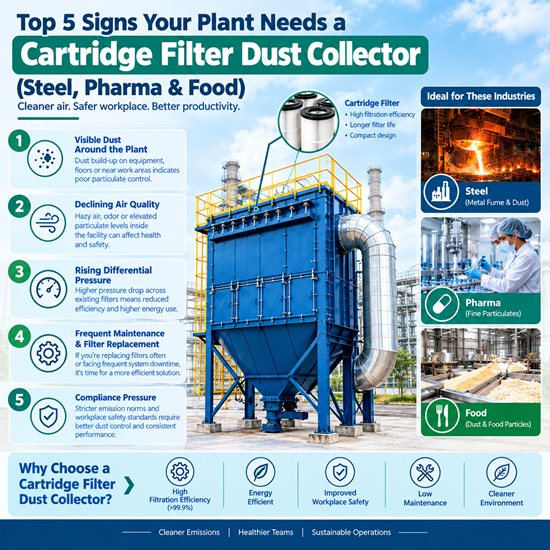
Not every plant needs the same dust collection technology. A Cement kiln and a pharmaceutical powder-handling room have nothing in common in terms of dust characteristics, space, or hygiene requirements — yet both need reliable particulate control matched correctly to their process. For a growing number of Steel, Pharma, and Food manufacturing plants, the Cartridge Filter has become the technology of choice over a traditional bag filter or baghouse, and the reasons come down to specific, measurable engineering factors, not just general preference.
Here are the five clearest signs it's time to consider one for your plant — with the technical reasoning behind each.

1. Your Plant Doesn't Have Room for a Traditional Baghouse
Baghouses and bag filter systems need considerable floor space and height — long filter bags, larger housings, and more extensive ducting. Many Steel and Pharma facilities, especially older or urban plants, simply don't have that footprint available, particularly when retrofitting dust collection into an existing production area.
The sign: You're evaluating dust collection for a space-constrained area — a packaging line, a mixing/blending room, a material transfer point — where a full-size baghouse won't physically fit.
The technical reason: Cartridge Filters use pleated filter media packed into a compact cylindrical cartridge, which dramatically increases filtration surface area per unit of housing volume compared to a cylindrical bag of the same diameter. This directly changes the achievable air-to-cloth ratio — the volume of air processed per unit of media area — allowing a correctly sized cartridge system to handle the same airflow in a fraction of the footprint a bag filter would need.
2. Your Process Involves Fine Powders or Sub-Micron Dust
Pharmaceutical API handling, food ingredient processing, and certain fine metal powder operations in Steel manufacturing all generate very fine particulate — often in the sub-micron to a few-micron range. Standard bag filters, designed around coarser industrial dust, don't always achieve the filtration efficiency these applications require.
The sign: Your process generates fine powder that a standard filter struggles to capture efficiently, resulting in visible dust escape, filter media loading issues, or repeated efficiency testing failures.
The technical reason: Cartridge media is typically rated by micron efficiency (e.g. sub-micron to 1-5 micron capture ranges depending on media grade), and the pleated construction provides significantly more effective filtration area within the same housing footprint than woven bag media — which directly improves fine-particle capture efficiency at a given face velocity.
3. Hygiene and Cross-Contamination Are Non-Negotiable
This is the sign that separates Pharma and Food applications from most other industries. In these sectors, dust collection isn't just about emission control — it's about GMP compliance, batch integrity, and preventing cross-contamination between products or production runs.
The sign: Your quality or compliance team has flagged concerns about product contamination risk, cleanability of your current dust collection equipment, or GMP audit findings related to air handling.
The technical reason: Cartridge Filter housings for Pharma/Food applications are typically specified with electropolished stainless steel construction, quick-release access doors for tool-free cartridge changeout, and in some configurations, washable or single-use cartridge options — reducing cross-contamination risk between batches. For higher-purity requirements, a HEPA afterfilter stage can be added downstream of the primary cartridge for additional outlet air purity, as shown in the process flow diagram above.
4. You're Dealing with Frequent Filter Clogging or High Pressure Drop
If your current dust collection system requires constant filter changes, shows a steadily rising pressure drop between cleaning cycles, or triggers frequent maintenance call-outs, it may simply be mismatched to your actual dust characteristics.
The sign: Maintenance logs show increasing frequency of filter replacement or cleaning cycles, and pressure drop readings are consistently trending upward faster than expected.
The technical reason: Cartridge Filters use pulse-jet cleaning, triggered automatically by a differential pressure (DP) sensor once the pressure drop across the media reaches a set threshold — a short burst of compressed air travels back through the cartridge, dislodging the accumulated dust cake into the hopper below. If a system is undersized for its actual air-to-cloth ratio, the cleaning cycle can't keep pace with cake buildup, causing chronically rising pressure drop regardless of how often it's cleaned. Correct sizing against actual dust loading — not catalog defaults — is what fixes this.
5. Your Industry Has Explosion or ATEX-Related Dust Concerns
Combustible dust is a real risk in several Steel process areas (fine metal powder, certain alloy dust) and in some Food industry operations (grain, sugar, starch dust). Where explosion risk is a factor, dust collection equipment needs to meet appropriate explosion-protection standards — not just general filtration performance.
The sign: Your plant's combustible dust assessment has flagged a process area where standard, non-rated filtration equipment doesn't meet the required safety standard.
The technical reason: Combustible dust classification is based on specific explosibility parameters — including Kst (deflagration index) and Pmax (maximum explosion pressure) — determined through dust testing for your specific material. These parameters determine whether explosion venting, isolation valves, or suppression systems are required on the filter housing. This is not a generic "explosion-proof" checkbox — it has to be specified against your dust's actual tested classification, which is why confirming this directly with your equipment manufacturer, based on your dust's test data, is essential rather than optional.
Why Steel, Pharma & Food Specifically Choose Cartridge Filters
|
|
|
|
|
|
|
|
|
|
|
|
|
|
|
|
Across all three, the common thread is the same: a need for compact, high-efficiency, easy-to-clean filtration engineered against specific technical parameters — air-to-cloth ratio, micron efficiency rating, and where relevant, dust explosibility class — that a standard bag filter or baghouse isn't always well suited to deliver.
What to Check Before You Choose a Cartridge Filter System
- Dust characteristics — particle size distribution, moisture content, and combustibility (Kst/Pmax if applicable)
- Required air-to-cloth ratio for your actual dust loading, not a generic catalog figure
- Required filtration efficiency for your specific compliance standard (especially in Pharma)
- Cleaning method — pulse-jet cleaning frequency, DP sensor set-point, and its impact on cartridge life
- Space and layout constraints at the installation point
- Explosion protection requirements, specified against your dust's tested classification, if applicable
- Access for maintenance — cartridge replacement frequency and ease of servicing
- Whether a HEPA afterfilter stage is needed for higher-purity Pharma applications
A manufacturer should walk through these factors against your actual process before recommending a system size and configuration — not sell a standard unit off a catalog.
Batliboi EEG's Cartridge Filter Solutions

Cartridge Filter — Batliboi Environmental Engineering Group
Batliboi Environmental Engineering Group manufactures Cartridge Filters engineered specifically for the compact footprint, hygiene, and fine-particulate demands of Steel, Pharma, Food, Cement, Ceramics, Metal Processing, Powder Coating, Plastic, and Chemical industry applications across Maharashtra, Gujarat, and beyond. With in-house manufacturing and 500+ successful pollution control projects, Batliboi EEG designs each Cartridge Filter system around your actual dust characteristics, air-to-cloth ratio requirements, and space constraints, rather than offering a one-size-fits-all unit.
If any of the five signs above sound familiar, it's worth reviewing your current dust collection setup. Explore Batliboi's Cartridge Filter product page or get in touch for a process-specific recommendation.
Frequently Asked Questions
1. What is a Cartridge Filter dust collector? A Cartridge Filter is a compact dust collection system that uses pleated filter media packed into a cylindrical cartridge, offering high filtration surface area in a smaller footprint than traditional bag filters, with automatic pulse-jet cleaning triggered by a differential pressure sensor.
2. What is air-to-cloth ratio and why does it matter for Cartridge Filters? Air-to-cloth ratio is the volume of air processed per unit of filter media area. Cartridge Filters' pleated design allows a higher effective media area within a given housing size, enabling a favorable air-to-cloth ratio in a compact footprint — but the system still needs to be sized against your actual dust loading, not a generic figure.
3. Are Cartridge Filters suitable for GMP-compliant Pharma manufacturing? Yes, when specified with electropolished stainless steel construction, quick-release access for cartridge changeout, and where needed, a downstream HEPA afterfilter stage for additional outlet purity. Specific configuration should be confirmed with the manufacturer based on your compliance requirements.
4. Can Cartridge Filters handle combustible dust? Cartridge Filter systems can be engineered with explosion-protection features, but the correct protection level (venting, isolation, or suppression) depends on your dust's tested Kst (deflagration index) and Pmax (maximum explosion pressure) values — not a generic "explosion-proof" rating.
5. How does the pulse-jet cleaning cycle work? A differential pressure (DP) sensor monitors the pressure drop across the cartridge media. Once it reaches a pre-set threshold, a short burst of compressed air is triggered back through the cartridge, dislodging the accumulated dust cake into the hopper below — keeping pressure drop within its designed operating range.
6. Why do Steel plants use Cartridge Filters if they already have Bag Filters elsewhere? Larger Steel plants often use multiple dust collection technologies across different process areas. Cartridge Filters are typically used at specific points with fine metal dust, combustible dust classification requirements, or space constraints, while Bag Filters or ESPs handle higher-volume, coarser dust elsewhere in the plant.
7. Who manufactures Cartridge Filters for Steel, Pharma, and Food industries in India? Batliboi Environmental Engineering Group manufactures Cartridge Filters engineered for Steel, Pharma, Food, and related industry applications across Maharashtra, Gujarat, and Pan India, with in-house manufacturing and 500+ completed projects. Contact Batliboi EEG to discuss your requirements.