How to Choose the Right Bag Filter for Your Cement or Steel Plant
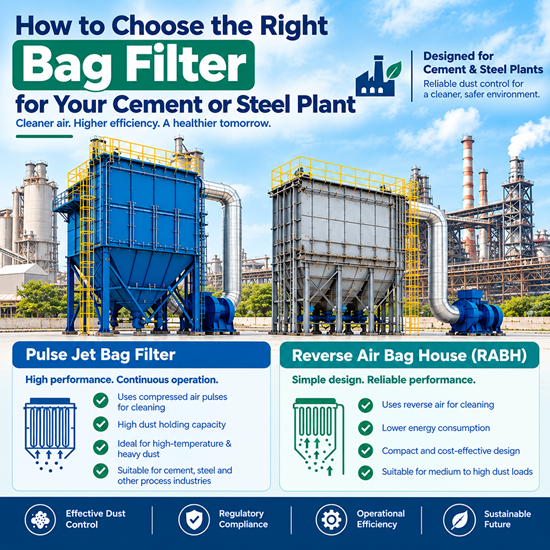
Cement and Steel plants are two of the heaviest users of bag filter technology in industrial air pollution control — but "bag filter" isn't one product. The two dominant designs, Pulsejet Bag Filter and Reverse Air Bag House (RABH), use fundamentally different cleaning mechanisms, and each is genuinely better suited to different operating conditions. Choosing between them based on price alone, without matching the technology to your actual dust load and process, is one of the most common and costly mistakes plants make. This guide breaks down exactly how to choose.
The Core Difference: Cleaning Mechanism
Both technologies filter dust-laden air through fabric bags — the difference is entirely in how the collected dust is removed from the bags to keep the system running:

Pulsejet Bag Filter uses online cleaning — a high-pressure burst of compressed air is fired back through each bag row in sequence, dislodging the accumulated dust cake, while the rest of the system continues filtering without interruption. This happens automatically and continuously during operation.
Reverse Air Bag House (RABH) uses offline cleaning — one compartment at a time is isolated from the gas stream, and a reverse airflow (rather than a compressed air pulse) gently collapses the bags to dislodge dust, while the remaining compartments continue filtering. RABH also uses inverted bag mounting — bags are open at the bottom and hang from the top, mounted at hopper level, the opposite orientation to a standard pulsejet bag filter.
This single design difference — online pulse cleaning vs offline reverse-air cleaning — is what drives nearly every other practical difference between the two technologies.
Technical Comparison: Pulsejet Bag Filter vs RABH
|
|
|
|
|
|
|
|
|
|
|
|
|
|
|
|
|
|
|
|
|
|
|
|
|
|
|
|
|
|
|
|
|
|
|
|
|
|
|
|
Step-by-Step: How to Choose Between Them
Step 1: Establish Your Actual Dust Load
This is the single biggest deciding factor. Pulsejet Bag Filters are designed to handle dust loads from 1 gm/Nm³ up to 2,000 gm/Nm³ — a very wide range that comfortably covers high-dust-load applications. RABH is designed for 1 gm/Nm³ up to 100 gm/Nm³; above that, a pre-collection system (such as a cyclone) is required ahead of the RABH to bring the load into range. If your process generates consistently high particulate loading, Pulsejet is very likely the better starting point.
Step 2: Check Your Temperature Range
Both technologies handle ambient temperatures up to 240°C as standard, with custom system configurations available for applications running hotter than that. Confirm your actual process gas temperature, including peak conditions, against the media and system rating — not just typical operating temperature.
Step 3: Weigh Operating Cost Against Capital Cost
RABH's offline reverse-air cleaning produces a notably lower pressure drop across the system than pulsejet cleaning, which translates directly into lower fan energy consumption and very low utility consumption overall. Pulsejet systems require a compressed air supply for the pulse cleaning cycle, adding an ongoing utility cost. For continuous, high-volume operations — common in Cement plants — RABH's lower operating cost can outweigh its narrower dust load range over the system's lifetime.
Step 4: Consider Maintenance Requirements
RABH is generally the lower-maintenance option, since reverse-air offline cleaning is gentler on bag life than repeated high-pressure pulse cleaning. Pulsejet systems include an automated cleaning system designed to optimize utility consumption, but the cleaning mechanism itself is more mechanically active, which typically means more frequent bag wear monitoring.
Step 5: Match to Your Plant Type
- Cement plants — often favor RABH for continuous, high-volume kiln and raw mill exhaust where dust loads are within RABH's range and low operating cost matters over years of continuous operation.
- Steel plants — frequently favor Pulsejet Bag Filters at process points with higher or more variable dust loads (EAF, sinter plant, material handling), where the wider dust load range and compact footprint are the priority.
- Many larger plants in both industries use both technologies at different points in the same facility, matched to each specific process area's dust characteristics.
Step 6: Factor In Footprint and Layout Constraints
Pulsejet Bag Filters have a more compact design for a given airflow, which matters in space-constrained retrofit situations. RABH systems, particularly for high-volume continuous applications, typically require a larger footprint for an equivalent gas volume.
Step 7: Confirm On-Demand Safety and Application Fit
For applications with combustible dust or specific safety requirements, confirm what additional safety features (such as on-demand safety systems) are available and appropriate for your specific dust classification — this varies by application and should be confirmed directly against your process.
Applications Both Technologies Serve
Both Pulsejet Bag Filters and RABH are versatile across Steel, Cement, Minerals, Power Plants, Metal Processing, Chemicals, and more — the choice between them comes down to your specific dust load, operating cost priorities, and footprint constraints at each application point, not the industry category alone.
Batliboi EEG's Bag Filter Solutions

Pulsejet Bag Filter — Batliboi Environmental Engineering Group
Batliboi Environmental Engineering Group manufactures both Pulsejet Bag Filters, engineered for dust loads from 1 to 2,000 gm/Nm³ with a compact design and automated cleaning, and Reverse Air Bag Houses (RABH), engineered for continuous high-volume filtration with very low operating cost and maintenance. With in-house manufacturing and 500+ successful pollution control projects across Steel, Cement, Minerals, Power, Metal Processing, and Chemical industries, Batliboi EEG sizes each system against your actual dust load, temperature, and operating cost priorities — not a single default product.
If you're unsure which technology fits your process, get in touch with Batliboi EEG's technical team for a process-specific recommendation.
Frequently Asked Questions
1. What is the main difference between a Pulsejet Bag Filter and an RABH? The difference is the cleaning mechanism. Pulsejet Bag Filters use online cleaning — a compressed air pulse cleans bags while filtration continues uninterrupted. RABH uses offline cleaning — one compartment is isolated and cleaned with reverse airflow while others keep filtering, with bags mounted in an inverted orientation.
2. Which handles higher dust loads, Pulsejet or RABH? Pulsejet Bag Filters handle a much wider dust load range — 1 gm/Nm³ up to 2,000 gm/Nm³ — compared to RABH's 1 to 100 gm/Nm³. Above 100 gm/Nm³, an RABH system needs a pre-collection stage (such as a cyclone) ahead of it.
3. Which has lower operating cost, Pulsejet or RABH? RABH generally has lower operating cost due to lower pressure drop across the system and very low utility consumption, since its offline reverse-air cleaning doesn't require a compressed air pulse system the way Pulsejet cleaning does.
4. Is RABH suitable for Steel plants with high dust loads? It depends on the specific process point. RABH's 100 gm/Nm³ dust load ceiling means high-dust-load Steel plant applications (such as EAF melt shops) often need a Pulsejet Bag Filter instead, or a pre-collection system paired with RABH if its lower operating cost is a priority.
5. What temperature range can these bag filters handle? Both Pulsejet Bag Filters and RABH systems handle ambient temperatures up to 240°C as standard, with custom system configurations available for applications running hotter than that.
6. Which requires less maintenance, Pulsejet or RABH? RABH is generally the lower-maintenance option, since its offline reverse-air cleaning is gentler on bag life compared to Pulsejet's repeated high-pressure pulse cleaning cycles.
7. Who manufactures Pulsejet Bag Filters and RABH systems for Cement and Steel plants in India? Batliboi Environmental Engineering Group manufactures both Pulsejet Bag Filters and Reverse Air Bag Houses for Steel, Cement, Minerals, Power, Metal Processing, and Chemical industry applications across India, with in-house manufacturing and 500+ completed projects. Contact Batliboi EEG to discuss your requirements.