How to Choose the Right Scrubber for a Chemical Plant
Chemical plants deal with an emission profile most other industries don't: corrosive gases, soluble toxic compounds, sticky or hygroscopic dust, and in some processes, combustible particulate — often all in the same gas stream. A dry filtration technology that works well in a cement plant can fail outright in a chemical plant, which is exactly why wet scrubbing is the default choice for this sector. But "scrubber" covers several distinct designs, and picking the wrong one is a common, expensive mistake. This guide walks through how to choose correctly.

Wet scrubbing and particulate control equipment — Batliboi Environmental Engineering Group
Why Chemical Plants Specifically Need Wet Scrubbing
Three characteristics of chemical plant emissions point toward wet scrubbing technology over dry filtration:
- Soluble gaseous pollutants — SO₂, HCl, HF and similar gases are only effectively controlled by absorption into a liquid, something dry technologies like bag filters or ESPs cannot do at all, since they only address particulate.
- Sticky, hygroscopic, or reactive dust — dust that absorbs moisture or reacts chemically tends to clog and blind dry filter media or foul ESP collection plates. A wet environment handles this kind of dust without the re-entrainment or fouling problems dry technology runs into.
- Combustible or flammable dust risk — in processes where dust is combustible, the wet environment inside a scrubber suppresses sparks and significantly reduces fire and explosion risk compared to a dry collection system.
How a Venturi Scrubber Works

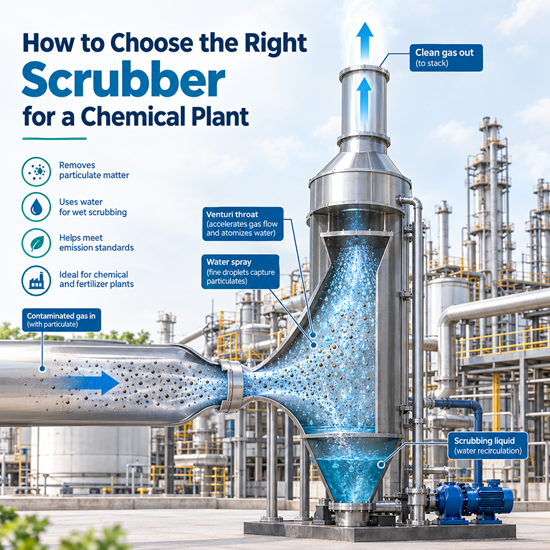
A venturi scrubber uses a venturi throat — a narrowed section of duct — to accelerate the gas stream to high velocity while scrubbing liquid is injected into it. The acceleration atomizes the liquid into fine droplets, and the resulting turbulence brings gas and liquid into intense contact. Particulate is captured through impaction (particles colliding with droplets) and interception, while soluble gases like SO₂, HCl, and HF are captured through absorption directly into the liquid. A mist eliminator downstream separates the now-laden droplets from the clean gas before it exits to the ID fan and stack. Captured material leaves as effluent/slurry, typically routed to wastewater treatment or a liquid recycle loop.
This combination — simultaneous particulate and gas removal in one unit — is one of the main reasons venturi scrubbers suit chemical plants specifically, where both pollutant types are often present together.
Types of Scrubbers and Where Each Fits
|
|
|
|
|
|
|
|
|
|
|
|
|
|
|
|
|
|
|
|
For a chemical plant handling both fine particulate and soluble acid gases from the same process, a Venturi Scrubber is generally the strongest single-unit choice. Where the primary concern is gas absorption alone with minimal particulate, a Packed Bed Scrubber can be more efficient and lower-maintenance, since particulate isn't present to foul the packing media.
Step-by-Step: How to Choose the Right Scrubber
Step 1: Identify What You're Actually Removing
Determine whether your process generates primarily particulate, primarily soluble gas, or both together. This single factor drives the entire technology decision — a scrubber optimized for gas absorption alone may underperform on particulate, and vice versa.
Step 2: Characterize the Particulate (If Present)
Is the dust sticky, hygroscopic, or reactive? Is it combustible? These characteristics rule out dry technology and point specifically toward wet scrubbing — but they also affect scrubber design details like liquid-to-gas ratio and material selection.
Step 3: Identify the Specific Gases Requiring Absorption
SO₂, HCl, and HF each have different solubility characteristics and may require specific reagent additions to the scrubbing liquid (rather than plain water) to achieve required removal efficiency — this is a chemistry question as much as an equipment question.
Step 4: Assess Corrosiveness and Material Selection
Chemical plant gas streams are frequently corrosive. Scrubber construction — from the throat and vessel to internals and ducting — needs to specify corrosion-resistant materials matched to the actual chemical composition of your gas and liquid streams, not a generic mild-steel default.
Step 5: Check Fluctuation Tolerance
Chemical processes often have variable dust concentration and gas flow rate, sometimes including upset or emergency conditions. Venturi scrubbers handle fluctuating loads well due to their high-energy, turbulent contact mechanism — an important factor if your process isn't running at constant steady-state conditions.
Step 6: Plan for Liquid Handling and Wastewater Treatment
Wet scrubbing generates effluent or slurry that requires treatment or recycling — as shown in the process flow diagram above. This is a real system, not an afterthought, and needs to be sized and budgeted alongside the scrubber itself.
Step 7: Confirm Emergency/Upset Capability, If Relevant
Some chemical plants specify scrubbers partly for emergency control of toxic releases — a scenario requiring the system to handle a sudden, high-concentration gas surge safely. If this applies to your plant, confirm the scrubber's design accounts for this operating mode, not just normal steady-state conditions.
Applications Venturi Scrubbers Are Built For
- Removal of fine particulates, including submicron dust
- Absorption of soluble gases — SO₂, HCl, HF
- Emergency control of toxic releases
- Waste-to-energy plants, Cement and lime kilns, Chemical and fertilizer plants, Steel and non-ferrous metal smelters, Biomass and coal-fired boilers
Key Advantages to Look For in a Chemical Plant Scrubber
- High removal efficiency on both particulate and soluble gas
- Effective handling of sticky, hygroscopic, or reactive dust without clogging or re-entrainment
- Spark and fire risk suppression for combustible or flammable dust applications, from the wet operating environment
- Tolerance for fluctuating dust concentrations or variable gas flow rates
- Compact design suitable for high dust loads
- Simultaneous removal of gases and particulates in a single unit, reducing the equipment footprint compared to separate dry filtration plus a gas absorption stage
Batliboi EEG's Venturi Scrubbers for Chemical Plants
Batliboi Environmental Engineering Group manufactures Venturi Scrubbers engineered for particulate emission control and soluble gas absorption in Chemical and Fertilizer plants, along with Waste-to-Energy, Cement and Lime Kilns, Steel and Non-Ferrous Metal Smelters, and Biomass and Coal-Fired Boiler applications. With in-house manufacturing and 500+ successful pollution control projects, each scrubber is engineered around your specific dust and gas characteristics, corrosiveness, and flow variability — not sold as a generic catalog unit.
Explore the Venturi Scrubber product page or get in touch for a process-specific recommendation.
Frequently Asked Questions
1. Why do chemical plants need wet scrubbers instead of bag filters or ESPs? Chemical plants often generate soluble gaseous pollutants (SO₂, HCl, HF) that dry technologies like bag filters and ESPs cannot remove at all, along with sticky, hygroscopic, or reactive dust that tends to clog or foul dry filtration media. Wet scrubbing handles both particulate and gas absorption in one system.
2. What's the difference between a Venturi Scrubber and a Packed Bed Scrubber? A Venturi Scrubber accelerates gas through a narrowed throat with injected liquid, making it effective for both fine particulate and gas absorption together. A Packed Bed Scrubber uses liquid flowing over packing media, making it more efficient for gas absorption alone but less suited to heavy particulate loads, which can clog the packing.
3. Can a Venturi Scrubber handle combustible dust safely? Yes. The wet operating environment inside a Venturi Scrubber suppresses sparks and significantly reduces fire and explosion risk compared to dry collection technology, making it a common choice for combustible or flammable dust applications.
4. What happens to the liquid and captured material after scrubbing? Captured particulate and absorbed gas leave the scrubber as effluent or slurry, which is typically routed to a wastewater treatment system or a liquid recycle loop — this needs to be planned and sized as part of the overall system, not treated as incidental.
5. Does a scrubber need special materials for corrosive chemical plant gas? Yes. Chemical plant gas streams are frequently corrosive, and the scrubber's throat, vessel, and internals need to be specified in corrosion-resistant materials matched to your actual gas and liquid chemistry — a generic mild-steel construction is not sufficient for most chemical plant applications.
6. Can a scrubber handle sudden fluctuations in gas flow or dust concentration? Venturi Scrubbers generally handle fluctuating loads well due to their high-energy, turbulent gas-liquid contact mechanism, making them suitable for chemical processes with variable flow rates or, in some designs, emergency control of toxic gas releases.
7. Who manufactures Venturi Scrubbers for chemical and fertilizer plants in India? Batliboi Environmental Engineering Group manufactures Venturi Scrubbers for Chemical and Fertilizer plants, along with Waste-to-Energy, Cement, Steel, and Biomass/Coal-Fired Boiler applications across India, with in-house manufacturing and 500+ completed projects. Contact Batliboi EEG to discuss your requirements.