Wet ESP vs Dry ESP: Which Electrostatic Precipitator Suits Your Coke Oven Gasifier?
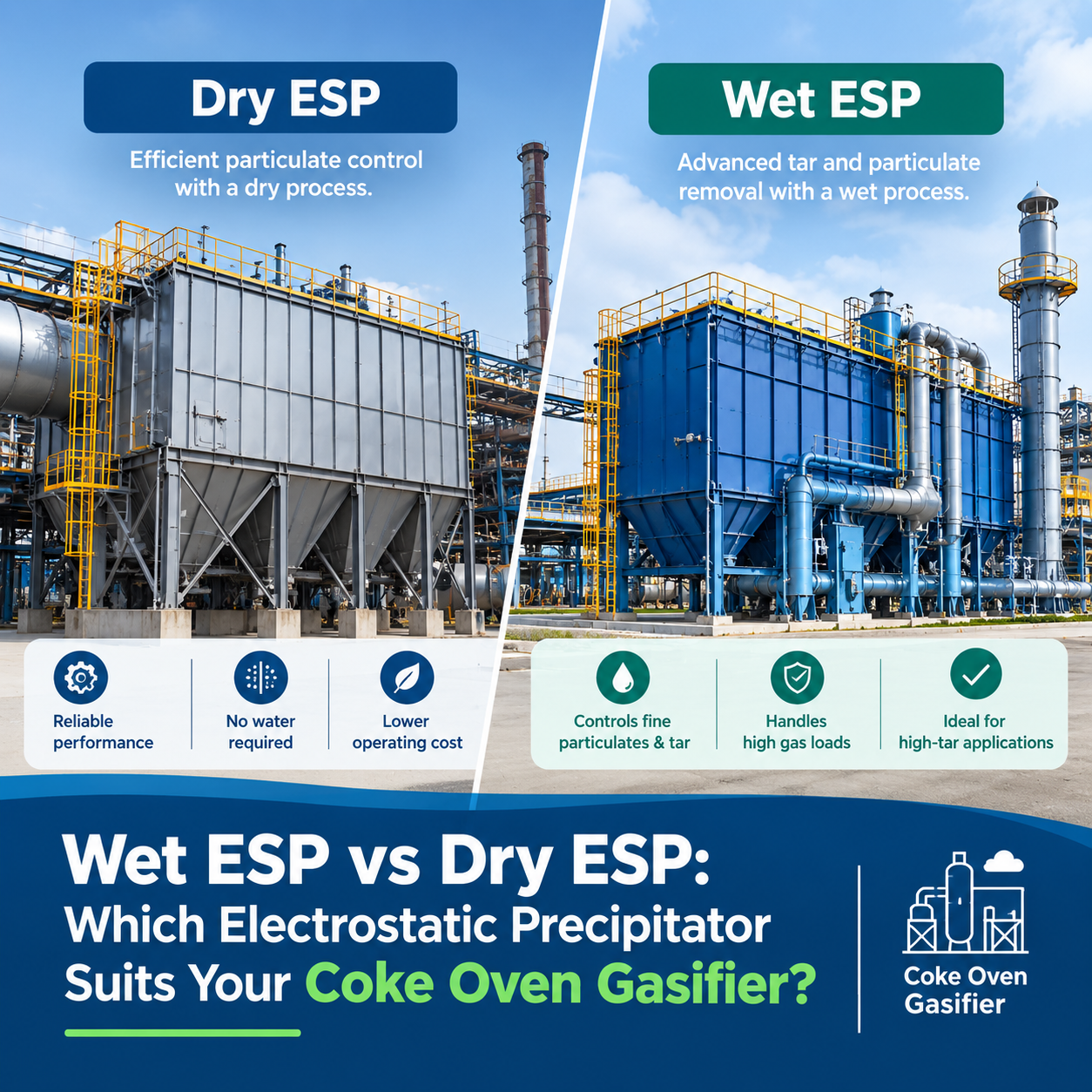
Electrostatic Precipitators (ESPs) are among the most efficient technologies available for cleaning very large gas volumes — but "ESP" isn't a single product. Wet ESP and Dry ESP operate on the same corona-discharge principle, yet the plate-cleaning mechanism, sizing parameters, and construction differ enough that choosing the wrong one for a coke oven gasifier is one of the most expensive mistakes a plant can make in emission control design. This guide covers the engineering detail behind both.

ESP applications across Steel, Power, Cement and Coke Oven processes — Batliboi Environmental Engineering Group
How an Electrostatic Precipitator Works
Both Wet and Dry ESP operate on the same core mechanism: gas passes through a chamber where discharge electrodes generate a corona — a region of ionized gas — that imparts a negative electrical charge onto particulates suspended in the gas stream. The charged particles migrate toward grounded, oppositely charged collection plates under the influence of the electric field, where they accumulate before being removed from the system.
The migration velocity of a particle toward the collection plate — and therefore how efficiently it's captured — depends on particle size, the field strength applied, and critically, the electrical resistivity of the dust itself. This resistivity dependency is what makes ESP fundamentally different from filtration-based technologies like bag filters, and it's also central to why Wet and Dry ESP are engineered differently.
The diagram below shows how the technology selection decision actually works, from gas assessment through to discharge:
Where Wet and Dry ESP Diverge: Plate Cleaning Mechanism
The single design decision that separates Wet from Dry ESP is how collected material is removed from the plates — and this is what determines which gas streams each is suited to.
Dry Electrostatic Precipitator (Dry ESP)
In a Dry ESP, collected particulate is removed from the collection plates by mechanical rapping (vibration or impact), which dislodges accumulated dust into a hopper below.
Technical fit:
- Dry, free-flowing particulate with resistivity in a moderate range — very high or very low resistivity dust both cause collection problems (excessively high resistivity causes "back corona," which actually reduces efficiency)
- High-volume, high-temperature gas streams — Batliboi's Dry ESP range is engineered to handle process temperatures from ambient up to 400°C
- Applications like DRI Kiln off-gas, where dust is largely dry mineral/metallic particulate
Key advantages:
- Handles very high gas volumes efficiently with low pressure drop compared to filtration-based technologies
- Lower water/wastewater handling requirement, and lower long-term operating cost as a result
- Well suited to continuous, high-temperature operation typical of DRI Kiln, Cement, Power, and Steel process applications
- Consistent, constant efficiency across varying load conditions when correctly sized
Limitations:
- Not effective on sticky, wet, or tar-laden particulate — rapping doesn't fully dislodge material that adheres to plates
- Performance can degrade sharply outside the design resistivity range, regardless of mechanical condition
Wet Electrostatic Precipitator / Electrostatic Tar Precipitator (Wet ESP)
In a Wet ESP, collected material is washed off the collection plates continuously or intermittently using a liquid (typically water), rather than mechanical rapping.
Technical fit:
- Tar mist and acid mist from Coke Oven Gasifier off-gas
- Sticky or wet particulate that would foul a Dry ESP's plates and cause progressive efficiency loss
- Corrosive gas streams, provided the ESP is built with appropriate corrosion-resistant materials (this is a construction decision, not automatic)
Key advantages:
- Effectively handles tar and acid mist that a Dry ESP cannot
- Continuous plate washing prevents particulate buildup, avoiding the resistivity and back-corona issues that plague Dry ESP on sticky dust
- Better suited to corrosive gas streams when constructed with corrosion-resistant materials
Limitations:
- Generates wastewater that requires treatment/handling — an added system, not just a design detail
- Higher maintenance complexity tied to the washing and water-handling system
- Not the most efficient or cost-effective choice for dry, high-volume mineral dust applications, where Dry ESP performs better at lower operating cost
Wet ESP vs Dry ESP: Technical Comparison
|
|
|
|
|
|
|
|
|
|
|
|
|
|
|
|
|
|
|
|
|
|
|
|
|
|
|
|
|
|
|
|
|
|
|
|
|
|
|
|

Why Coke Oven Gasifier Applications Specifically Need Wet ESP
Coke oven off-gas combines three conditions that make Dry ESP a poor technical fit:
- Tar content — Tar condenses on collection surfaces and doesn't dislodge with mechanical rapping the way dry dust does. Tar buildup on a Dry ESP's plates would progressively reduce the effective collection area and increase the risk of equipment damage over time.
- Acid mist — Acidic components in coke oven gas are corrosive, and combined with moisture, demand a wet collection approach engineered for corrosion resistance from the outset — not retrofitted onto a dry design.
- Resistivity behavior of sticky particulate — Unlike dry mineral dust, coke oven particulate's adhesive, tar-laden nature causes it to build up on dry collection surfaces in a way that continuous water washing is specifically engineered to prevent.
This is precisely why the product is often called an "Electrostatic Tar Precipitator" (ETP) in coke oven contexts — it's a Wet ESP engineered specifically around tar and acid mist handling.
Sizing Parameters That Determine Actual Performance
Beyond choosing Wet or Dry, correct ESP sizing depends on:
- Specific Collection Area (SCA) — the ratio of total plate area to gas volume treated; this is the primary parameter governing achievable collection efficiency for a given dust
- Migration velocity — determined by particle size, field strength, and dust resistivity; used together with SCA to calculate expected efficiency (via the Deutsch-Anderson relationship, the standard ESP sizing equation)
- Gas residence time — how long the gas remains within the field zone, which must be sufficient for particle migration to the plates before the gas exits
- Dust resistivity range — for Dry ESP specifically, resistivity outside the optimal range causes either re-entrainment (too low) or back-corona (too high), both of which reduce efficiency independent of plate area
- Rapping intensity and frequency (Dry ESP) — too aggressive causes dust re-entrainment into the gas stream; too infrequent causes excessive cake buildup and reduced field strength
When Would a Coke Oven Plant Still Consider Dry ESP?
In practice, Dry ESP is rarely the right primary choice for coke oven gasifier off-gas due to the tar and acid mist issue above. Some plants use a combination approach — for example, a Dry ESP or other dry particulate control stage elsewhere in the process (such as at a DRI Kiln, if the plant has one), paired with a dedicated Wet ESP specifically for the coke oven gasifier stream. Technology selection should always follow the actual gas and particulate characteristics at each point in the process, not a single blanket choice across the whole plant.
Batliboi's Dry ESP — Built for a Wide Operating Range
Dry Electrostatic Precipitator — Batliboi Environmental Engineering Group
Batliboi's Dry ESP range is engineered for constant efficiency across a wide range of operating volumes and temperature conditions — from ambient up to 400°C — with low operating cost from reduced pressure drop compared to filtration-based alternatives, serving Steel, Cement, Minerals, Power, Metal Processing, and Chemical industries.
How to Decide: Questions to Ask Before Choosing
- Does your gas stream contain tar, acid mist, or sticky particulate? → Wet ESP
- Is your particulate dry, free-flowing, and within a moderate resistivity range (e.g. DRI Kiln)? → Dry ESP
- Can your site handle the wastewater treatment a Wet ESP requires?
- What are the corrosion characteristics of your gas stream, and does the ESP construction account for them?
- Has SCA and migration velocity been calculated against your actual dust characteristics, or only against a generic application category?
A manufacturer with experience in both technologies should walk through these questions against your actual process data before recommending a system — not simply sell the product they specialize in.
Batliboi EEG: Both Technologies, Engineered for Your Process
Batliboi Environmental Engineering Group manufactures both Dry Electrostatic Precipitators, engineered for high-volume applications like DRI Kiln off-gas across a wide temperature range, and Wet ESP / Electrostatic Tar Precipitators, purpose-built for tar and acid mist handling in Coke Oven Gasifier applications across Gujarat and beyond. With in-house manufacturing and 500+ successful projects, Batliboi EEG sizes each system against actual SCA, resistivity, and gas characteristics rather than a one-size-fits-all approach.
If you're unsure which technology fits your process, get in touch with Batliboi EEG's technical team for a process-specific recommendation.
Frequently Asked Questions
1. What is the main difference between Wet ESP and Dry ESP? The difference lies in how collected particulate is removed from the collection plates. Dry ESP uses mechanical rapping to dislodge dry dust into a hopper, while Wet ESP uses water washing to remove sticky, wet, or tar-laden particulate that rapping can't effectively clean off.
2. What is Specific Collection Area (SCA) and why does it matter? SCA is the ratio of total collection plate area to gas volume treated, and it's the primary parameter governing achievable ESP efficiency for a given dust. Two ESPs handling the same gas volume but sized with different SCA will achieve different collection efficiencies.
3. Why does dust resistivity affect Dry ESP performance? Dust resistivity affects how easily charge transfers at the collection plate. Very high resistivity causes "back corona," which reduces efficiency, while very low resistivity can cause particles to lose their charge and re-entrain into the gas stream. Both reduce collection efficiency independent of plate area.
4. Why is Wet ESP preferred for coke oven gasifier applications? Coke oven off-gas contains tar and acid mist that adheres to collection surfaces and cannot be effectively removed by mechanical rapping. Wet ESP's water-washing mechanism handles this sticky, corrosive particulate far more effectively than Dry ESP, and avoids the resistivity issues tar buildup would cause on a dry system.
5. Does a Wet ESP require wastewater treatment? Yes. Since Wet ESP uses water to wash collected particulate off the plates, the resulting wastewater typically requires treatment or handling as part of the overall system design.
6. What temperature range can a Dry ESP handle? Batliboi's Dry ESP range is engineered to handle process temperatures from ambient up to approximately 400°C, making it suitable for high-temperature applications like DRI Kiln, Cement, and Power plant off-gas.
7. How do I know which ESP type is right for my plant? The right choice depends on your gas stream's particulate type, resistivity, moisture content, corrosiveness, and temperature — assessed against SCA and migration velocity calculations, not just a generic industry category. Contact Batliboi EEG for a process-specific assessment.