Air Pollution Control System for Steel Plant : Effective Systems, Technologies and Best Practices
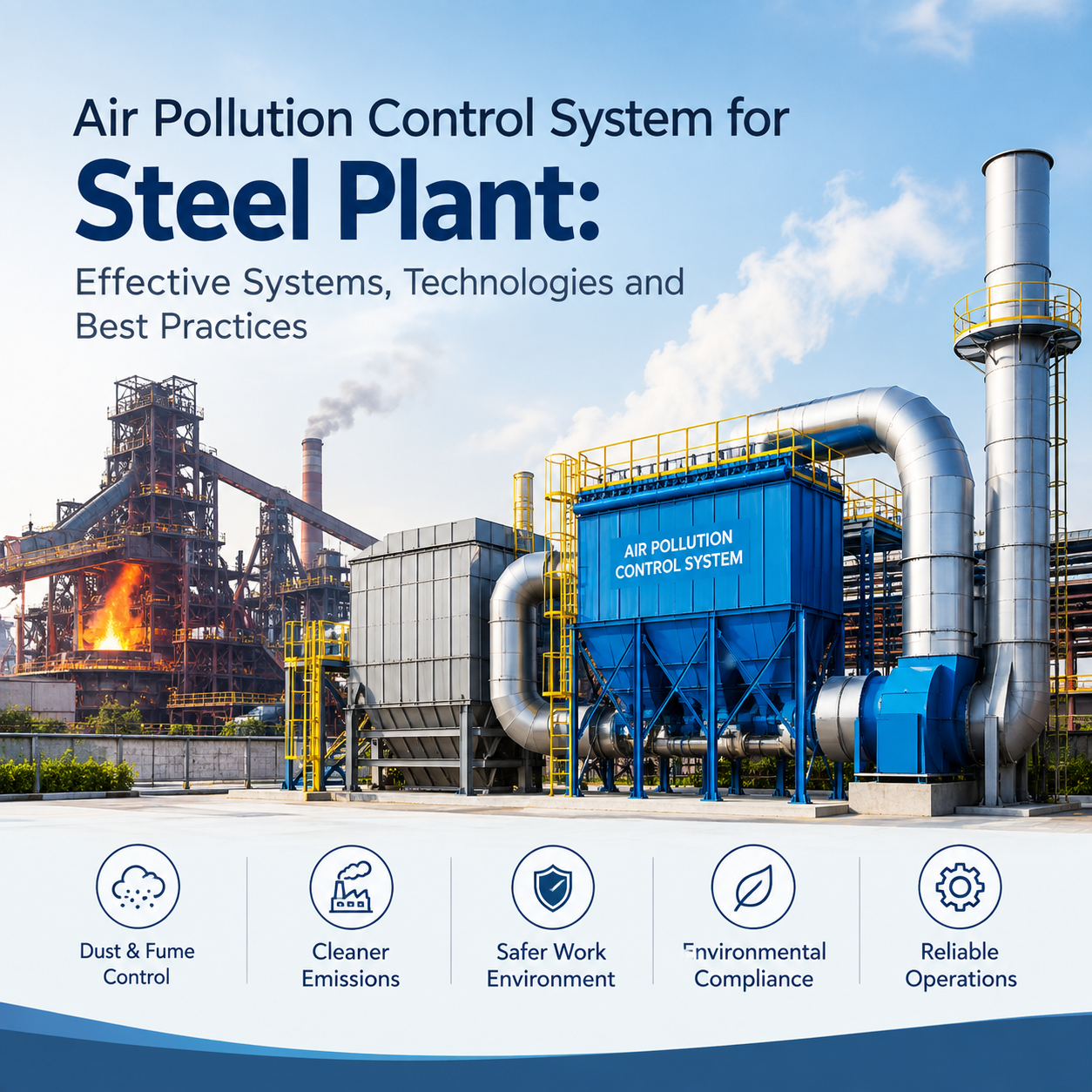

The steel industry plays an important role in industrial development and infrastructure. However, steel manufacturing involves processes such as melting, heating, casting, material handling and refining that can generate dust, fumes, particulate matter and gaseous emissions.
Effective air pollution control in the steel industry therefore requires properly engineered systems that can capture pollutants at their source, transport contaminated gases safely and treat them using suitable filtration or gas-cleaning technologies.
Depending on the process and emission characteristics, steel plants may require technologies such as Fume Extraction Systems, Pulsejet Bag Filters, Electrostatic Precipitators, Reverse Air Bag Houses, Wet ESPs, Scrubbers and other specialized pollution-control systems.
Batliboi Environmental Engineering Group offers a broad range of Air Pollution Control solutions designed for industrial applications, including steel manufacturing and other process industries.
Why Is Air Pollution Control Important in Steel Plants?
Steel manufacturing can generate emissions at several stages of production. The nature and concentration of these emissions vary depending on the process, furnace type, raw materials and operating conditions.
Common sources can include:
- Electric Arc Furnaces
- Induction Furnaces
- Blast Furnaces
- BOF/LD Converters
- Secondary metallurgical processes
- Material handling
- Charging and tapping operations
- Casting operations
- Grinding and finishing
- Fuel combustion
These processes can produce dust, metallic fumes, particulate matter and gaseous pollutants.
An effective pollution-control strategy helps industries:
- Capture emissions at the source
- Reduce particulate emissions
- Control furnace fumes
- Improve process-area air conditions
- Protect downstream equipment
- Support environmental compliance
- Improve operational reliability
- Reduce uncontrolled dust and fume dispersion
The correct APC system should always be selected according to the specific process and emission characteristics rather than using a single technology for every application.
Major Air Pollution Sources in Steel Manufacturing
Understanding the emission source is the first step in designing an effective pollution-control system.
1. Electric Arc Furnace
Electric Arc Furnaces can generate high-temperature, dust-laden gases containing metallic oxides and other process emissions during scrap or DRI melting.
These gases require effective extraction and treatment before discharge.
2. Induction Furnace
Induction furnace operations can generate metallic fumes and fine particulate emissions during melting.
Source extraction through suitable hoods and downstream filtration can help control these emissions.
3. Blast Furnace
Blast furnace operations can generate dust and gaseous emissions, particularly around cast house and tapping areas.
The extraction arrangement needs to be designed according to the specific emission source.
4. BOF/LD Converter
Basic Oxygen Furnace operations generate high-temperature gases and particulate emissions during oxygen blowing.
The system may require appropriate gas capture, cooling and downstream pollution-control equipment.
5. Secondary Metallurgical Units
Processes such as ladle refining and vacuum degassing can generate localized metallic fumes and dust.
Local extraction systems can be designed to capture these emissions at the source.
Batliboi's FES solution specifically identifies EAF, induction furnace, blast furnace, BOF/LD converter, cupola furnace and secondary metallurgical units as applications, with different extraction and pollution-control configurations depending on the furnace and emission characteristics.
Effective Air Pollution Control Systems for Steel Plants
There is no single APC technology suitable for every steel-making process. The right solution depends on parameters such as:
- Gas temperature
- Gas flow rate
- Dust loading
- Particle characteristics
- Moisture
- Chemical composition
- Process conditions
- Required emission performance
- Available plant space
Below are some of the important technologies used for industrial air pollution control.

1. Fume Extraction System (FES)
A Fume Extraction System (FES) is designed to capture hot, dust-laden gases and fumes directly from industrial processes before they spread into the work environment.
Typical applications include:
- Electric Arc Furnaces
- Induction Furnaces
- Blast Furnaces
- BOF/LD Converters
- Secondary Metallurgical Units
A typical system consists of:
Emission Source → Extraction Hood → Ducting → Cooling → Filtration → ID Fan → Stack
Depending on process conditions, the system can incorporate cooling arrangements, bag filters or electrostatic precipitators.
Key design parameters include:
- Gas flow and temperature
- Dust concentration
- Furnace/process characteristics
- Cooling requirements
- Filtration technology
- Required emission levels
FES helps improve workplace air quality, control industrial emissions and support compliance with applicable environmental requirements.
2. Pulsejet Bag Filter
A Pulsejet Bag Filter is an industrial dust-collection system designed to remove particulate matter from process gases.
Dust-laden gas passes through filter bags, where particles are captured on the filter media. Compressed-air pulses periodically clean the bags and remove accumulated dust.
Applications include:
- Steel plants
- Cement plants
- Foundries
- Mineral processing
- Chemical industries
- Power plants
Important design parameters include:
- Gas flow
- Dust concentration
- Gas temperature
- Particle characteristics
- Filter media
- Pressure drop
- Cleaning requirements
Pulsejet bag filters provide continuous filtration with automatic bag cleaning and are suitable for many high-dust industrial applications.
3. Electrostatic Precipitator (ESP)
An Electrostatic Precipitator (ESP) removes particulate matter from industrial gas streams using an electrostatic charging and collection process.
Particles in the gas are electrically charged and attracted towards collecting electrodes, where they accumulate and are subsequently removed.
Applications include:
- Power plants
- Steel industries
- Cement plants
- Process industries
- Boilers
- High-volume industrial exhaust systems
Important design parameters include:
- Gas flow
- Gas temperature
- Dust concentration
- Particle characteristics
- Electrical properties of dust
- Required collection efficiency
Batliboi offers Dry Electrostatic Precipitators as part of its Air Pollution Control solutions.
ESP technology is particularly suitable for applications requiring continuous handling of large gas volumes and particulate emissions.
4. Wet ESP / Electrostatic Tar Precipitator
A Wet Electrostatic Precipitator (W-ESP) or Electrostatic Tar Precipitator (ETP) is designed to remove fine particulate matter, mist, tar, aerosols and other difficult-to-capture contaminants from industrial gas streams.
Unlike dry ESP systems, collected material is removed using liquid flushing.
Applications include:
- Steel industries
- Coke ovens
- Chemical industries
- Power plants
- Processes generating tar or oily particles
- Acid mist and aerosol control
Important design parameters include:
- Gas flow
- Gas temperature
- Particle characteristics
- Tar/aerosol concentration
- Moisture content
- Gas corrosiveness
- Required collection performance
W-ESP/ETP systems are particularly useful where sticky, condensable or fine pollutants make conventional dry filtration difficult.
5. Reverse Air Bag House (RABH)
A Reverse Air Bag House (RABH) is an industrial filtration system used for removing particulate matter from large-volume gas streams.
The system uses reverse airflow to clean the filter bags. During cleaning, airflow in the selected compartment is reversed, causing accumulated dust to detach from the bags and fall into the hopper.
Applications include:
- Steel plants
- Cement plants
- Power plants
- Mineral processing
- Metal industries
- Chemical industries
Important design parameters include:
- Gas volume
- Dust loading
- Gas temperature
- Dust characteristics
- Filter media
- Pressure drop
- Cleaning cycle
RABH systems are suitable for high-volume applications and can provide efficient dust collection with relatively low utility and maintenance requirements.
6. Scrubber Systems
Scrubber Systems are air pollution control equipment used to remove particulate matter and/or gaseous pollutants from industrial gas streams.
Batliboi's APC portfolio includes:
- Venturi Scrubbers
- Gas Conditioning Scrubbers
- Saturated Venturi
Venturi Scrubbers are primarily used for particulate removal and can also assist in controlling certain soluble gases.
Gas Conditioning Scrubbers are designed for gas cooling, conditioning and control of gaseous pollutants through wet, dry or semi-wet processes.
Saturated Venturi systems provide effective gas-liquid contact and can be used for gas cooling, humidification and pre-conditioning before downstream pollution-control equipment.
Important design parameters include:
- Gas flow
- Gas temperature
- Pollutant concentration
- Dust loading
- Scrubbing medium
- Pressure drop
- Required removal efficiency
Scrubber configuration is selected according to the specific gas characteristics and pollution-control requirements.

Retrofit Solutions for Existing Steel Plants
A new APC system is not always necessary.
Existing steel plants may benefit from retrofit and performance-enhancement solutions when:
- Production capacity has increased
- Process conditions have changed
- Existing equipment is ageing
- Emission performance needs improvement
- Energy consumption is high
- Existing filtration equipment is underperforming
- Additional extraction points are required
A retrofit assessment can help determine whether existing equipment can be modified, upgraded or integrated with additional pollution-control technology.
Batliboi specifically lists Retrofit Solutions for Existing System and Performance Enhancement within its APC portfolio.

Why an Integrated APC Approach Is Important
Air pollution control should not be viewed as a single piece of equipment.
A complete system may involve:
Source Capture + Ducting + Cooling + Filtration + Fan + Stack + Controls
For example:

This integrated approach allows each component to work together as part of the overall emission-control system.

Benefits of an Efficient Air Pollution Control System
A properly engineered APC system can help steel plants achieve:
- Effective particulate control
- Furnace fume capture
- Controlled gas extraction
- Better plant air conditions
- Improved equipment protection
- Reduced uncontrolled emissions
- Support for environmental compliance
- Better process reliability
- Improved operational efficiency
- Opportunities for performance enhancement through retrofit solutions
The actual performance depends on appropriate system design, operating conditions, equipment selection and maintenance.
Conclusion
Effective air pollution control in the steel industry requires more than selecting a single filtration unit. Steel plants generate different types of emissions at different stages of production, making source capture, gas conditioning, filtration and system integration essential parts of an effective APC strategy.
Technologies such as Fume Extraction Systems, Pulsejet Bag Filters, Electrostatic Precipitators, Wet ESPs, Reverse Air Bag Houses and Scrubbers can be evaluated according to the specific process and emission characteristics.
With a broad APC portfolio covering particulate, fume and gas-control applications, Batliboi Environmental Engineering Group can provide engineered solutions for industrial pollution-control requirements.
Looking for an Air Pollution Control System for your steel plant?
Explore Batliboi's Air Pollution Control solutions or contact the Environmental Engineering Group to discuss your application and system requirements.
Frequently Asked Questions
Q.What is an Air Pollution Control System for a steel plant?
An Air Pollution Control System for a steel plant is an integrated system designed to capture, transport and treat dust, fumes and other process emissions generated during steel manufacturing.
Q.Which pollution-control equipment is used in steel plants?
Depending on the application, steel plants may use Fume Extraction Systems, Bag Filters, Electrostatic Precipitators, Wet ESPs, Reverse Air Bag Houses, Scrubbers and other specialized equipment.
Q.Which APC system is suitable for an Electric Arc Furnace?
An EAF can require a dedicated Fume Extraction System with suitable extraction, cooling and particulate-control equipment. The final configuration depends on furnace capacity, gas volume, temperature, dust loading and other process parameters.
Q.What is the role of a Bag Filter in a steel plant?
A Bag Filter captures particulate matter from dust-laden industrial gas streams. Its design depends on gas flow, temperature, dust characteristics, filter media and required performance.
Q.What is the difference between a Bag Filter and ESP?
A Bag Filter uses filter media to mechanically capture particulate matter, while an ESP uses electrostatic forces to collect charged particles. The appropriate technology depends on the process and gas characteristics.
Can an existing steel plant's APC system be upgraded?
Yes. Existing systems can potentially be upgraded or retrofitted depending on their condition, process requirements and performance limitations. Batliboi offers retrofit and performance-enhancement solutions as part of its APC portfolio.
Q.Why is Fume Extraction important in steel plants?
Fume extraction captures hot, dust-laden gases close to their source and routes them to appropriate cooling and pollution-control equipment. This helps prevent uncontrolled dispersion of fumes within the plant environment.
Q.Does Batliboi provide Air Pollution Control Systems for steel plants?
Batliboi Environmental Engineering Group provides a range of Air Pollution Control technologies and identifies Steel Industry among its served industries.