Wet Electrostatic Precipitator (ESP) Manufacturer in Gujarat: Applications & Benefits Explained
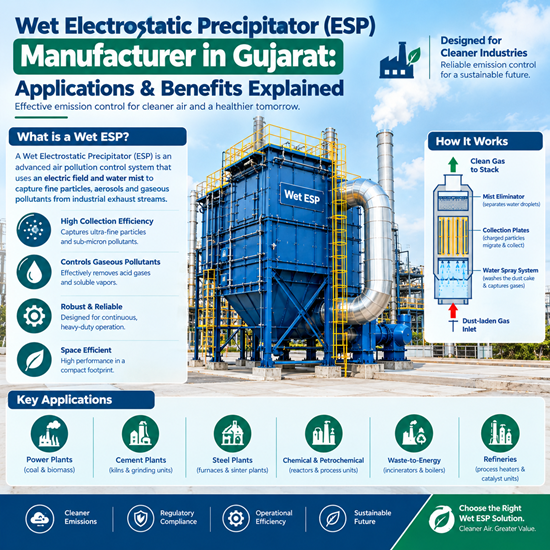

Wet ESP / Electrostatic Tar Precipitator (W-ESP/ETP) — Batliboi Environmental Engineering Group
Gujarat's industrial base is built on processes that produce the hardest kind of emissions to control: chemical and petrochemical manufacturing, steel, foundries, paper and pulp, and a fast-growing battery recycling sector. A lot of what these processes emit is not dry dust. It is tar, acid mist, sulfuric acid fumes, and heavy hydrocarbon aerosols, which are sticky, oily, and corrosive. Dry filtration technology struggles with exactly this kind of emission, and this is where the Wet Electrostatic Precipitator (Wet ESP) earns its place. This guide explains how a Wet ESP works, where it is applied, and what benefits to expect.
What Is a Wet Electrostatic Precipitator?
A Wet ESP, also called an Electrostatic Tar Precipitator (ETP) in coke oven and gasifier contexts, controls particulate emissions in industries handling sticky or tar-like particles. It works on the same electrostatic principle as a dry ESP, but adds water or liquid sprays to improve particle removal and to keep the collection surfaces clean.
That one addition changes what the equipment can handle. A dry ESP removes collected dust by mechanical rapping, which fails on sticky material. A Wet ESP washes the plates instead, so tar and mist do not build up and degrade performance.
How a Wet ESP Works: Process Flow

Step 1: Gas inlet. Process gas carrying tar, acid mist, or sticky particulate enters the precipitator.
Step 2: Charging zone. Discharge electrodes create a corona, a region of ionized gas, that electrically charges the tar droplets, mist, and particles in the gas stream.
Step 3: Collection zone. The charged droplets and particles migrate to the collection plates under the electric field and collect on the wetted surfaces.
Step 4: Water flushing. A water flushing system washes the collected tar and particles off the plates automatically. This is what allows continuous operation with minimal maintenance, since the plates never accumulate a layer that would reduce field strength.
Step 5: Effluent handling. The washed-off tar and liquid drain from the unit and go to treatment or tar recovery before reuse or disposal.
Step 6: Clean gas to stack. The cleaned gas passes through the ID fan, which provides the airflow through the system, and is discharged within permitted emission limits.
Why Gujarat Plants Need Wet ESP Technology
Gujarat concentrates several industries whose emissions suit wet electrostatic collection:
- Chemical and petrochemical belts such as Vapi, Ankleshwar, Dahej, and Bharuch generate acid mist, sulfuric acid fumes, and hydrocarbon aerosols from process vents.
- Steel and foundry clusters produce tar-bearing and condensable emissions at specific process points, including coke oven and gasifier off-gas where tar is present.
- Paper and pulp, and pharmaceutical units have process streams with condensable organics and mist that dry filters foul on.
- The battery recycling sector is expanding in the state, and its processes produce acid mist and fine, corrosive emissions.
Plants in these sectors operate under consent conditions from the Gujarat Pollution Control Board (GPCB), so emission control equipment has to perform consistently in practice, not just at commissioning. A Wet ESP's continuous plate flushing is what keeps performance stable on sticky emissions.
Key Benefits of a Wet ESP
- Captures what dry technology cannot. It is especially effective on aerosols, tars, and condensable organics that are difficult for dry ESPs or bag filters.
- Handles wet, sticky, and oily particles. It is well suited to tar, acid mist, sulfuric acid fumes, and heavy hydrocarbons in process gas.
- Low pressure resistance. The pressure drop is minimal, which makes it energy-efficient compared with mechanical scrubbers or filters.
- Automatic cleaning. Water flushing removes collected particles and tar automatically, so the unit runs continuously with minimal maintenance.
- Suitable for high-temperature, corrosive gas. It can handle harsh process conditions when built with the right materials.
- Compact modular design, which helps in space-constrained plants and retrofits.
- Material flexibility. Construction can be metallic or non-metallic depending on the process gas condition, which matters when the gas is acidic.
Where Wet ESPs Are Applied
The core applications are power plants, coke ovens, and waste incineration facilities, wherever sticky, tar-like particles are present. Across Batliboi's serving industries, Wet ESP is used in:
- Steel Industry, including coke oven and gasifier tar removal
- Chemicals, for acid mist and sulfuric acid fume control
- Paper and Pulp Industry
- Foundry Industry
- Solar & Semiconductor Industry
- Pharmaceutical Industry
- Battery Recycling Industry
Wet ESP vs Dry ESP: A Quick Decision Rule
If your gas is dry and free-flowing, a dry ESP is usually the more economical choice. If it carries tar, acid mist, or sticky and oily particulate, a dry ESP's plates will foul regardless of sizing, and a Wet ESP is the technically sound option. For the full comparison, including sizing parameters and resistivity effects, read our guide on Wet ESP vs Dry ESP for coke oven gasifier applications.
What to Check Before You Choose a Wet ESP
- Gas composition. Confirm the presence and concentration of tar, acid mist, or hydrocarbon aerosols, not just overall dust load.
- Corrosiveness. Specify construction materials, metallic or non-metallic, against your actual gas chemistry.
- Gas temperature and volume at the inlet, including peak conditions.
- Water and effluent handling. Plan the flushing water supply and the treatment or tar recovery route for the effluent as part of the system.
- Required outlet limit your GPCB consent conditions demand.
- Space and layout. A compact modular design helps, but confirm fit for retrofit situations.
- Vendor experience with comparable gas streams, plus local support for commissioning and maintenance.
Batliboi EEG: Wet ESP Manufacturer for Gujarat
Batliboi Environmental Engineering Group manufactures Wet ESP / Electrostatic Tar Precipitators (W-ESP/ETP) engineered for tar, acid mist, and sticky particulate across Steel, Chemicals, Paper and Pulp, Foundry, Solar & Semiconductor, Pharmaceutical, and Battery Recycling applications. With in-house manufacturing and 500+ successful pollution control projects, each unit is built around your actual gas composition, temperature, and corrosiveness, with materials selected to suit the process gas.
Explore the Wet ESP / Electrostatic Tar Precipitator product page or get in touch to discuss your Gujarat plant's requirements.
Frequently Asked Questions
1. What is a Wet Electrostatic Precipitator used for?
A Wet ESP controls particulate emissions in industries handling sticky or tar-like particles, such as coke ovens, power plants, and waste incineration facilities. It removes tar, acid mist, sulfuric acid fumes, and heavy hydrocarbons that dry collection technology cannot handle effectively.
2. How is a Wet ESP different from a Dry ESP?
Both use the same electrostatic charging and collection principle. The difference is plate cleaning: a Dry ESP uses mechanical rapping, while a Wet ESP uses water or liquid sprays to flush collected material off the plates automatically.
3. Is a Wet ESP the same as an Electrostatic Tar Precipitator?
In coke oven and gasifier contexts, yes. An Electrostatic Tar Precipitator (ETP) is a Wet ESP engineered for tar and acid mist handling.
4. Does a Wet ESP need a lot of maintenance? '
It is designed for continuous operation with minimal maintenance because the water flushing system removes collected tar and particles automatically, so the plates stay clean between service intervals.
5. Can a Wet ESP handle corrosive and high-temperature gas?
Yes, when built with suitable materials. Construction can be metallic or non-metallic depending on the process gas condition, which is how it is matched to acidic or corrosive streams.
6. Is a Wet ESP energy-efficient?
It offers minimal pressure resistance, which makes it energy-efficient compared with mechanical scrubbers or filters that impose a higher pressure drop on the gas stream.
7. Who manufactures Wet ESPs in Gujarat?
Batliboi Environmental Engineering Group manufactures Wet ESP / Electrostatic Tar Precipitators for industrial plants across Gujarat and Pan India, with in-house manufacturing and 500+ completed projects. Contact Batliboi EEG to discuss your requirements.