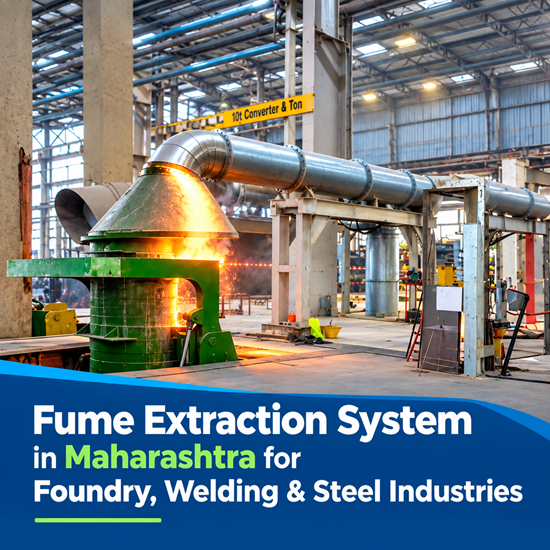
Fume Extraction System in Maharashtra for Foundry, Welding & Steel Industries
Maharashtra runs one of India's largest concentrations of foundry, welding, fabrication, and steel manufacturing capacity — from the Kolhapur-Ichalkaranji foundry belt (among the largest foundry clusters in the country) to the industrial estates around Pune, Aurangabad, Nashik, Nagpur, and the steel and sponge iron units around Chandrapur. That density of melting, pouring, and welding operations means one thing consistently: significant fume generation, and correspondingly heavy scrutiny from the Maharashtra Pollution Control Board (MPCB) on how that fume is managed.
If your plant sits in any of these clusters, a Fume Extraction System (FES) is no longer a nice-to-have — it's fast becoming a baseline requirement for both worker safety and regulatory standing. This guide covers what FES actually needs to do, how it's configured differently across foundry, welding, and steel applications, and what Maharashtra's regulatory environment specifically expects.
Why Maharashtra's Industrial Clusters Face Extra Scrutiny
Three factors make fume control a sharper priority for Maharashtra plants specifically:
- Cluster density — In concentrated industrial belts like Kolhapur's foundry cluster or the MIDC estates around Pune and Aurangabad, fugitive fume from one unit affects ambient air readings across the whole zone, which means MPCB inspection attention on one facility often triggers scrutiny of neighboring ones too.
- Mixed-scale operations — Maharashtra's foundry sector spans everything from small ancillary units to large integrated steel plants, and MPCB consent conditions increasingly apply fugitive-emission expectations across this whole range, not just to the largest facilities.
- CTO/CTE renewal scrutiny — Consent to Establish (CTE) and Consent to Operate (CTO) renewals in Maharashtra increasingly ask for documented fume/dust control measures at the process level, not just stack emission reports — meaning source-point fume extraction at furnaces and welding stations is now part of what gets reviewed.
What a Fume Extraction System Actually Does
An FES is a source-point capture and filtration system — it removes fume at the point of generation (a furnace mouth, a welding torch, a pouring station) before it disperses into the general work area, rather than relying on roof ventilation to clear it afterward. Captured fume travels through ducting (with cooling where the source temperature requires it) to a filtration unit, before clean air is discharged or recirculated.
The Fume Extraction Process, Step by Step
Understanding what actually happens inside an FES — not just the equipment list — helps explain why each stage is engineered the way it is:

Step 1 — Capture at the source. A hood, extraction arm, or canopy is positioned directly at the fume-generating point — the furnace mouth, the pouring ladle, the welding torch. Capture only works if the hood is close enough and the airflow strong enough to overcome cross-drafts in the work area; this is why hood placement matters more than simply increasing fan power.
Step 2 — Transport through ducting. Captured fume travels through a duct network sized to maintain adequate transport velocity — fast enough to keep particulate suspended in the airstream so it doesn't settle and build up inside the ducting, which would otherwise create blockages and fire risk over time.
Step 3 — Cooling, where required. High-temperature sources like EAF and BOF generate gas well above the maximum continuous operating temperature of standard filter media. A forced draft cooler or water-cooled duct section brings gas temperature down to a safe range before it reaches filtration — skipping this step is one of the most common causes of premature filter media failure.
Step 4 — Filtration. The cooled, transported fume passes through a bag filter or cartridge filter, where particulate is physically separated from the airstream. For sources with hot particulate carryover (such as Induction Furnaces), a spark arrestor stage sits ahead of the filter to prevent damage to the filter media.
Step 5 — Airflow via ID fan. An induced draft (ID) fan provides the negative pressure that draws air through the entire system — from hood, through ducting and filtration, to discharge. The fan is sized to overcome the combined resistance (static pressure) of every stage in the system, not just the filter itself.
Step 6 — Discharge or recirculation. Filtered air is released to atmosphere within permitted emission limits, or in some plant layouts, recirculated back into the shop floor — improving general indoor air quality and reducing energy loss from conditioned air, where the application allows it.
Furnace-Wise Equipment Requirements
FES configuration isn't uniform — it changes based on the specific furnace or process generating the fume. This is where a generic extraction system falls short of what foundry and steel operations actually need:
|
|
|
|
|
|
|
|
|
|
|
|
|
|
|
|
|
|
|
|
|
|
|
|
|
|
|
|
For Maharashtra's foundry belt specifically — heavily weighted toward Cupola and Induction Furnace operations — spark arrestor protection ahead of the bag filter (for IF) and cyclone pre-separation (for Cupola) are frequently the difference between a system that holds up under continuous operation and one that clogs prematurely.
Foundry, Welding & Steel: Application-Specific Configuration

Foundry Operations
Fume sources are spread across melting furnaces, pouring stations, shakeout/fettling, and core making — each needing its own capture point feeding into a shared or zoned filtration system, sized for the combined airflow of all points.
Welding Operations
Fixed welding bays typically use fixed extraction arms or hoods; mobile or on-floor welding may need portable extraction units; robotic welding cells are usually served by enclosed hoods built around the automated cell layout. Fume composition depends on base metal, filler material, and coatings, which affects filtration media selection.
Steel Plant Operations
FES is deployed at specific points — EAF/BOF melt shops, cast house/tapping areas, secondary metallurgical stations, and welding/fabrication bays for maintenance work — usually as one part of a broader plant-wide air pollution control strategy alongside ESP or Bag Filters at other process points.
Common Selection Mistakes Maharashtra Plants Should Avoid
- Treating FES as a generic, catalog-selected product instead of engineering it around the specific furnace type and plant layout
- Skipping spark arrestor protection on Induction Furnace applications — a frequent cause of premature bag filter damage in Maharashtra's IF-heavy foundry sector
- Under-sizing capture hoods, allowing fume to escape into the work area before extraction
- Ignoring retrofit constraints in older, space-constrained plant layouts common across Maharashtra's established industrial belts
- Sizing the header duct and filtration unit for a single capture point rather than the combined airflow of all connected points
Batliboi EEG's Fume Extraction Systems in Maharashtra
Batliboi Environmental Engineering Group designs Fume Extraction Systems engineered around the specific fume characteristics of each furnace type — EAF, Induction, Blast Furnace, BOF/LD Converter, Cupola, and secondary metallurgical units — as well as welding and fabrication applications, for Foundry, Welding, and Steel industry plants across Maharashtra's key industrial belts. With in-house manufacturing and 500+ successful pollution control projects, each FES is sized around actual fume sources, gas temperature, and plant layout — not a generic template — with local support for site visits, commissioning, and MPCB documentation needs.
Explore the Fume Extraction System (FES) product page or get in touch to discuss the right configuration for your Maharashtra plant.
Frequently Asked Questions
1. Is a Fume Extraction System mandatory for foundries in Maharashtra? Requirements vary by plant classification and CTO/CTE conditions, but MPCB's consent renewal process increasingly reviews fume and dust control at the process level, not just stack emissions. In practice, most foundry and welding operations in Maharashtra's industrial clusters need dedicated fume extraction to maintain consistent compliance.
2. Which furnace types are most common in Maharashtra's foundry sector, and does that affect FES design? Maharashtra's foundry belt, including clusters like Kolhapur-Ichalkaranji, is heavily weighted toward Cupola and Induction Furnace operations. Cupola furnaces typically need a cyclone pre-separator ahead of the bag filter, while Induction Furnaces need spark arrestor protection — both furnace-specific requirements that a generic FES design would miss.
3. Can a Fume Extraction System be retrofitted into an older Maharashtra plant? Yes. Many Maharashtra industrial units operate in older, space-constrained layouts, and FES retrofits are common — the system is engineered around existing layout, available space, and specific fume sources rather than requiring a new facility design.
4. What's the difference between FES requirements for a foundry versus a welding bay? Foundry fume sources (furnaces, pouring, shakeout) are typically fixed and multiple, requiring a zoned capture system, while welding fume sources may be fixed, mobile, or robotic, requiring different hood and ducting approaches depending on workstation layout.
5. Does MPCB inspect fugitive fume emissions, or only stack emissions? MPCB inspections increasingly cover fugitive emissions — fume escaping into the general work area or beyond plant boundaries — in addition to stack emission compliance, particularly in dense industrial clusters where ambient air quality is monitored zone-wide.
6. How is an FES sized for a steel plant with multiple fume sources (EAF, cast house, welding bays)? Each capture point is sized individually for its own airflow requirement, but the shared header duct, filtration unit, and ID fan must be sized for the combined airflow of all points operating simultaneously — a common design gap when systems are added incrementally without reassessing total capacity.
7. Who designs Fume Extraction Systems for foundry, welding, and steel plants in Maharashtra? Batliboi Environmental Engineering Group designs and manufactures furnace-specific Fume Extraction Systems for Foundry, Welding, and Steel industry applications across Maharashtra's industrial belts, with in-house manufacturing and 500+ completed projects. Contact Batliboi EEG to discuss your plant's requirements.