Dry Electrostatic Precipitator (ESP) for DRI Kiln: Complete Guide

Dry Electrostatic Precipitator (ESP) — Batliboi Environmental Engineering Group
India is the world's largest producer of direct reduced iron (DRI), also called sponge iron, and a large share of it comes from coal-based rotary kilns. These kilns produce a lot of useful metal, and they also produce a large volume of hot, dust-laden gas. Cleaning that gas reliably, day after day, is one of the hardest jobs in an iron and steel plant, and the Dry Electrostatic Precipitator (ESP) is the technology most sponge iron plants rely on to do it.
This guide explains how the DRI kiln gas path works, why a Dry ESP suits it, what makes the installation succeed or fail, and what to specify before you buy.
How a DRI Kiln Produces Dust and Gas
In the coal-based route, iron ore, non-coking coal and a flux such as dolomite are fed into an inclined rotary kiln. As the charge moves through, coal acts as the reducing agent and removes oxygen from the ore, leaving sponge iron. The gas leaving the kiln carries the by-products of that process:
|
|
|
|
|
|
|
|
|
|
|
|
|
|
|
|
|
|
|
|
|
|
|
|
|
|
|
|
The DRI Kiln Gas Cleaning Train

Step 1: Rotary kiln. Gas leaves the kiln hot and loaded with dust, carbon monoxide and sulphur dioxide.
Step 2: After-burner chamber. Air is introduced to burn off carbon monoxide and combustible volatiles. This reduces the fuel content of the gas and the risk of burning inside downstream equipment.
Step 3: Dust settling chamber. The gas slows down and the coarse dust drops out. Removing the heavy fraction here lowers the load on the ESP.
Step 4: Waste heat recovery boiler (optional). Many plants recover heat from the gas to generate steam and power. Plants without one go straight to cooling.
Step 5: Cooling and conditioning. Water spraying cools the gas to the temperature the ESP is designed for, and adds moisture. This stage is not just cooling. It sets the dust resistivity, which decides how well the ESP collects.
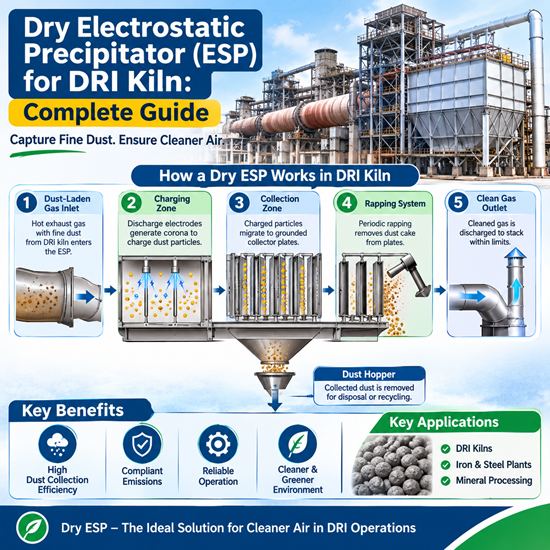
Step 6: Dry ESP. Charged dust particles migrate to collection plates and are periodically rapped off into hoppers.
Step 7: ID fan and stack. The induced draft fan pulls gas through the train, and the cleaned gas is released within consent limits.
Dust from the settling chamber and the ESP hoppers is conveyed to disposal or reuse.
Why a Dry ESP Suits a DRI Kiln
- High gas volumes. Kiln gas flows are large, and an ESP handles very high volumes without a heavy pressure penalty.
- Low operating cost. A Dry ESP has a low pressure drop, which keeps ID fan power down over years of continuous running. This is a key advantage of Batliboi's Dry ESP range.
- Constant efficiency. A correctly sized ESP holds its collection efficiency as load varies, rather than degrading between filter changes.
- Temperature tolerance. Batliboi's Dry ESP range offers options to suit temperatures from ambient up to 400°C, which covers the demanding duty of kiln gas.
- Dry, free-flowing dust. The dust from DRI kilns is largely dry, which is exactly the duty a mechanically rapped ESP is built for. For sticky or tar-laden streams the answer is different, as covered in our guide on Wet ESP vs Dry ESP.
- Fewer consumables. There are no filter bags to replace, so there is no recurring media cost.
ESP, Bag Filter or Hybrid for a DRI Kiln?
|
|
|
|
|
|
|
|
|
|
|
|
|
|
|
|
|
|
|
|
|
|
|
|
|
|
|
|
|
|
|
|
|
|
|
ESPs are the traditional choice for DRI kiln gas because of the volume and the variable moisture. Where the outlet limit is very tight or the dust resistivity is unfavourable, a Hybrid Filter, which pairs an ESP stage with a bag filter stage, is worth evaluating.
The Critical Factor: Dust Resistivity and Gas Conditioning
Resistivity is how easily electrical charge moves through the collected dust layer, and it is the single biggest factor in DRI kiln ESP performance.
- Resistivity too high: The dust layer holds charge and breaks down electrically, a condition called back corona. It reduces collection efficiency sharply.
- Resistivity too low: Particles lose their charge on the plate and can be carried back into the gas stream.
- In the workable range: The ESP collects as designed.
Resistivity changes strongly with gas temperature and moisture. This is why the cooling and conditioning tower matters so much. By controlling the temperature and moisture of the gas entering the ESP, the plant keeps resistivity in the range where the ESP performs. Sulphur dioxide in kiln gas can also help conditioning, and its presence should be taken into account in the design. A well-designed ESP behind a poorly operated conditioning tower will underperform, and many "ESP problems" in sponge iron plants are really conditioning problems.
Design Parameters for a DRI Kiln ESP
|
|
|
|
|
|
|
|
|
|
|
|
|
|
|
|
|
|
|
|
|
|
|
|
|
|
|
|
|
|
|
|
|
For the sizing logic behind SCA and migration velocity, see our guide on Wet ESP vs Dry ESP and our general ESP overview.
Safety: The Part Many Buyers Overlook
DRI kiln gas can contain carbon monoxide, and an ESP generates electrical sparks in normal operation. This combination needs deliberate design:
- CO and oxygen monitoring ahead of the ESP, with a trip interlock that switches off the high-voltage supply if the gas becomes unsafe.
- After-burner performance. The after-burner chamber should burn off CO reliably, so the ESP seldom sees a combustible mixture.
- Controlled air ingress. Leaks that admit air change the gas composition and the temperature.
- Explosion relief where the design requires it.
These are not options to be removed when budgets get tight. They protect the plant and the people working in it.
Operating Problems and Their Usual Causes
|
|
|
|
|
|
|
|
|
|
|
|
|
|
|
|
|
|
|
|
|
|
|
|
Many sponge iron plants already have an ESP that has aged or been outgrown. A structured audit followed by targeted upgrades can recover performance without a full replacement. Batliboi's retrofit solutions page explains how that process works.
Buyer's Checklist: 8 Questions Before You Order
- Is the ESP sized on measured gas data, including peak flow and moisture, rather than nameplate kiln capacity?
- Is resistivity addressed in the design, with a conditioning stage and margin for variation?
- What is the gas temperature margin above the acid dew point, and how is it protected at start-up and shutdown?
- Is there CO and oxygen monitoring with an automatic trip?
- How is gas distribution verified, by modelling or by testing?
- How are hoppers, insulators and the rapping system designed for reliability?
- What is the total operating cost, including fan power and maintenance?
- What spares, service and AMC support is available locally?
Common Mistakes
- Sizing the ESP on kiln capacity rather than real gas conditions
- Treating the conditioning tower as an accessory
- Removing CO and oxygen safety instrumentation to save cost
- Ignoring the acid dew point and hopper heating
- Choosing on price and discovering the energy and maintenance cost later
- Leaving ageing ESPs running without an audit as production rises
Batliboi EEG: Dry ESPs for Steel and Sponge Iron Plants
Batliboi Environmental Engineering Group manufactures Dry Electrostatic Precipitators with constant efficiency, very low operating cost from lower pressure drop, a wide range of operating volumes, and options for temperatures from ambient up to 400°C. The same range includes Forced Draft Coolers, a Gas Conditioning Scrubber, Hybrid Filters and retrofit solutions, so the gas path can be addressed as a system. With in-house manufacturing, 500+ successful pollution control projects and turnkey execution, each ESP is sized for your actual gas data.
Explore the Dry ESP product page and the Steel Industry page, or get in touch to discuss your DRI kiln.
Frequently Asked Questions
1. Why is a Dry ESP used on DRI kilns? DRI kiln gas is high in volume and carries largely dry, fine dust. A Dry ESP handles large volumes at low pressure drop, holds constant efficiency, and avoids the recurring cost of filter bags.
2. What is gas conditioning and why does it matter? Gas conditioning cools the kiln gas with water spray and adjusts its moisture before it reaches the ESP. This sets the dust resistivity, which decides whether the ESP collects well. Poor conditioning is one of the most common causes of poor ESP performance.
3. What is back corona? Back corona occurs when dust resistivity is too high. The collected dust layer breaks down electrically and releases ions that interfere with charging, which sharply reduces collection efficiency.
4. Is CO a safety issue for a DRI kiln ESP? Yes. Kiln gas can contain carbon monoxide, and an ESP produces sparks in normal operation. CO and oxygen monitoring with an automatic trip interlock, together with an effective after-burner, is an essential safeguard.
5. Can a bag filter be used instead of an ESP on a DRI kiln? It can, but moisture and acid dew point risks can blind and damage bags unless the gas is carefully managed, and large gas volumes require very large filter areas. ESPs are the traditional choice, and a Hybrid Filter is an option for very tight limits.
6. What temperature range can a Dry ESP handle? Batliboi's Dry ESP range offers options for temperatures from ambient up to 400°C. The actual design temperature should be set from your kiln gas data.
7. My existing ESP is losing efficiency. Do I need a new one? Not necessarily. An audit can identify whether the cause is conditioning, rapping, gas distribution, ageing internals or insufficient capacity. Targeted retrofit can often restore performance without full replacement, provided the main structure is sound.
8. Who manufactures Dry ESPs for DRI kilns in India? Batliboi Environmental Engineering Group manufactures Dry Electrostatic Precipitators for Steel, Cement, Power and related industries across India, with in-house manufacturing and 500+ completed projects. Contact Batliboi EEG to discuss your kiln.