Packed Bed Scrubbers for Battery Recycling: A Growing Industry Need

Air pollution control for the battery recycling industry — Batliboi Environmental Engineering Group
With the rise of electric vehicles, consumer electronics and grid-scale storage, end-of-life batteries are becoming a major waste stream. India's Battery Waste Management Rules make producers responsible for recycling, and that responsibility is building a fast-growing industry around recovering lithium, cobalt, nickel, lead and other critical materials from both lithium-ion and lead-acid batteries.
The recovery is valuable, but the process is not clean by default. Discharging, dismantling, shredding, smelting and acid leaching all release emissions that are hazardous to workers and to the surrounding community. Controlling them is not optional for a plant that wants to run safely and keep its consent to operate. The packed bed scrubber is one of the core technologies for doing it, and this guide explains where it fits, where it does not, and how to specify one.
Why Battery Recycling Emissions Are Hard to Control
The pollutants change with the recycling route, which means a single piece of equipment rarely covers the whole plant:
|
|
|
|
|
|
|
|
|
|
|
|
|
|
|
|
Two features make these emissions especially demanding. First, many are corrosive, so ordinary mild steel equipment fails quickly. Second, they are a mix of dust, gas and mist, and each of these responds to a different type of control.
What Is a Packed Bed Scrubber?
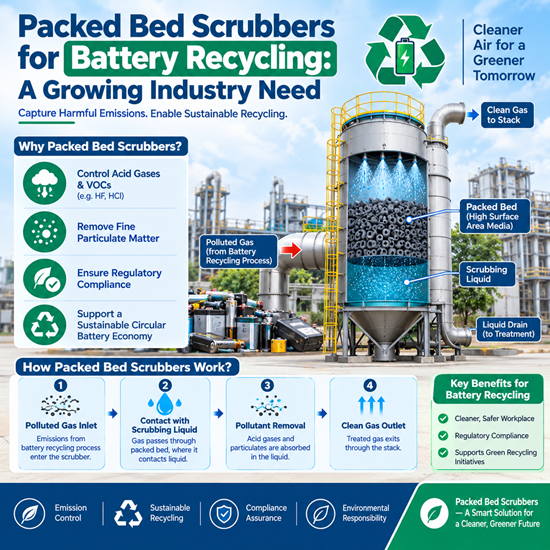
A packed bed scrubber is a vertical tower filled with packing material that creates a very large wetted surface. Gas flows upward through the bed while scrubbing liquid is distributed over the top and flows downward, so the two meet in counter-current. Pollutant gases dissolve into the liquid, often with a reagent in it to neutralise them. A mist eliminator at the top stops entrained droplets, and the liquid collects in a sump below, from where a pump recirculates it.
Counter-current flow is the key. The cleanest gas leaves in contact with the freshest liquid at the top, which drives removal efficiency very high for gases that dissolve or react readily.
How It Works in a Battery Recycling Plant: The Process

Step 1: Capture. Hoods, enclosures and ducting collect emissions at the source: the shredder, the discharge area, the furnace, the leaching tanks. Capturing at source keeps fugitive emissions out of the work area.
Step 2: Dust removal. Fine metal-laden dust is removed first, using a filter such as a cartridge filter or bag filter, or a venturi stage. This protects the packing from fouling.
Step 3: Packed bed scrubbing. The gas rises through the packing and meets the downward-flowing scrubbing liquid. Acid gases such as HF, HCl and SO₂ dissolve and are neutralised by the reagent in the liquid.
Step 4: Liquid recirculation and dosing. The liquid collects in a sump and is pumped back to the top. Reagent dosing holds the pH in the range that keeps absorption efficient.
Step 5: Bleed to effluent treatment. A controlled bleed removes spent liquid, which carries fluoride and dissolved metals and must be treated before reuse or discharge.
Step 6: Mist polishing. A mist eliminator or a Wet ESP captures acid mist and fine droplets that pass through the packed bed.
Step 7: ID fan and stack. An induced draft fan draws the gas through the whole train, and the treated air is discharged within permitted limits.
Why Packed Bed Scrubbers Suit This Industry
- High removal of acid gases. Counter-current contact with a reactive liquid removes HF, HCl, SO₂ and similar gases very effectively, which is the main gaseous hazard in this industry.
- Chemistry under control. Because the liquid is recirculated and dosed, the plant can tune absorption to the gas it is actually treating.
- Corrosion-resistant construction. Towers can be built in plastics and lined or fibre-reinforced materials that tolerate acidic and fluoride-bearing streams, where bare steel would not last.
- Handles continuous gas streams from furnaces and process vents at steady flow.
- Lower pressure drop than high-energy scrubbers, which keeps fan energy use down.
What a Packed Bed Scrubber Cannot Do Alone
Being honest about limits is what separates a design that works from one that disappoints:
- Fine dust fouls the packing. Dust-laden gas can clog the bed, so dust must be removed upstream by a Cartridge Filter, bag filter or Venturi Scrubber.
- Submicron mist passes through. Acid mist from leaching and processing is often too fine for a packed bed to capture well. A mist eliminator or Wet ESP handles this, and is listed among the products for the battery recycling industry.
- Organic vapours are not destroyed by water. Electrolyte solvent vapours from some lithium-ion routes are poorly absorbed in an aqueous scrubber and may need thermal oxidation or other treatment.
- Gas hazards need safety design. Flammable vapours require explosion-safe design of the capture and ducting, not just a scrubber.
This is why a battery recycling plant needs a multi-stage train, not a single scrubber: dust first, gas second, mist third, with organics treated separately where present.
Design Parameters That Decide Performance
|
|
|
|
|
|
|
|
|
|
|
|
|
|
|
|
|
|
|
|
|
|
|
|
|
|
|
|
|
|
One material point deserves emphasis. Fluoride is aggressive toward glass and silica-containing materials, so wetted parts and internals must be chosen for fluoride service. This is a specification point to settle with the manufacturer before ordering.
Lithium-Ion vs Lead-Acid: Different Problems
|
|
|
|
|
|
|
|
|
|
|
|
|
|
|
|
Plants handling both chemistries, or changing feedstock over time, should design for the widest range of emissions rather than only today's mix.
Regulation and Siting: Maharashtra and Gujarat
Battery recycling is expanding in several industrial states, including Maharashtra and Gujarat, which have established chemical, metals and logistics ecosystems. Plants operate under the Battery Waste Management Rules and under state pollution control board consent conditions, so the emission control design should be documented against the limits in the plant's consent. For Gujarat plants, the related guide on Wet ESP applications in Gujarat explains how mist control fits alongside gas scrubbing.
Buyer's Checklist: 8 Questions Before You Order
- Has the emission inventory been mapped by process stage, including dust, gas, mist and organic vapour?
- Is there a dust removal stage ahead of the packed bed?
- Is there a plan for submicron acid mist, with a mist eliminator or Wet ESP?
- Are materials specified for the actual chemistry, including fluoride?
- How is pH controlled, and does dosing follow the load?
- Where does the spent liquid go, and is effluent treatment sized for fluoride and metals?
- Is the capture system safe for flammable vapours?
- Does the supplier offer spares and service, so the plant stays compliant as volumes grow?
Common Mistakes
- Relying on a single scrubber for dust, gas and mist
- Skipping the dust stage and letting the packing foul within months
- Specifying materials without checking them against fluoride service
- Under-sizing effluent treatment for the bleed stream
- Ignoring organic vapours from lithium-ion electrolyte
- Designing for today's feedstock without allowing for a changing mix
Batliboi EEG: Air Pollution Control for Battery Recycling
Batliboi Environmental Engineering Group serves the battery recycling industry with air pollution control equipment for the stages described above, including Wet ESP / Electrostatic Tar Precipitators for acid mist, Venturi Scrubbers for particulate and gas control, and filters for dust. With in-house manufacturing, 500+ successful pollution control projects and turnkey execution, each system is engineered around the plant's actual emission profile rather than supplied as a single default unit.
Explore the Battery Recycling Industry page or get in touch to discuss your plant's emission control requirements.
Frequently Asked Questions
1. Why do battery recycling plants need scrubbers? Recycling releases corrosive and toxic gases, including acid gases and, in some lithium-ion routes, hydrogen fluoride, along with fine metal-laden dust and acid mist. A scrubber absorbs the gases into a liquid so that they are not released to the atmosphere.
2. How does a packed bed scrubber work? Gas flows upward through a tower of packing while scrubbing liquid flows downward over it. The large wetted surface lets pollutant gases dissolve and react with the reagent in the liquid. A mist eliminator removes droplets, and a sump and pump recirculate the liquid.
3. Can a packed bed scrubber remove fine dust? Not well. Dust can clog the packing, so it should be removed first by a filter or a venturi stage. The packed bed is for gas absorption, not dust collection.
4. What controls acid mist in battery recycling? Acid mist from leaching and processing is very fine and often passes through a packed bed. A mist eliminator or a Wet ESP is used to capture it.
5. Does a scrubber remove electrolyte solvent vapours? Not reliably. Many organic electrolyte vapours are poorly absorbed in water-based scrubbers and may need thermal oxidation or other dedicated treatment.
6. What materials suit hydrogen fluoride service? Fluoride attacks glass and silica-containing materials, so wetted parts and internals must be chosen for fluoride service. Confirm material selection with the manufacturer against your actual gas chemistry.
7. What happens to the scrubbing liquid? A controlled bleed removes spent liquid, which carries fluoride and dissolved metals. It must go to effluent treatment before reuse or discharge, and that treatment should be sized as part of the system.
8. Who supplies air pollution control for battery recycling plants in India? Batliboi Environmental Engineering Group supplies air pollution control equipment for the battery recycling industry, including Wet ESPs, scrubbers and filters, with in-house manufacturing and 500+ completed projects. Contact Batliboi EEG to discuss your requirements.